How I actually get good advice
Every 6 months, I spend 2 weeks intensively gathering advice from people who are much more experienced and successful than me at what we do at PostHog. I’ve talked with people who have scaled some of the most successful software companies in the world and built tools that millions use every day. What I learned from them has fundamentally changed how we do things at PostHog. I also increasingly have people asking me for advice about what they should do with their company. The main thing I’ve learned from both sides of the conversation is that getting good advice doesn’t just happen. It’s a skill. These are the things I do to get good advice. Be intentional and cast a wide net
My process is:
You need to talk to multiple people because they will all say different things, even if they worked at the same company. Pick companies that serve a similar ideal customer profile. If you are building a devtool, get advice about sales from someone at GitHub, not LinkedIn. If you are product-led, talk to someone from Figma, not Salesforce. Cold messaging works because people are nice, but you need to a) have mutuals, and b) ask a specific question. Don’t say “I’d love to pick your brain” – a specific question from you lessens the mental load for them so they can be helpful. Here’s basically the message I send:
“But Charles, that won’t work for me – I’m not a fancy generic exec person like you are!” Maybe I’m weird, but I hop on calls with people I don’t know about once a week to give them advice. Usually the ones I’ve said yes to have done similar to the above – if your story resonates, people will want to help you out. Here’s an example of a message I received a couple of weeks ago that led to a call:
Ask the “right” peopleHow do I know that people have done something successfully? Sure, LinkedIn, but that doesn’t give the full picture… Honestly – I can’t really know! But I still learn something useful in every call:
Generally, I’ve found that the most helpful people have done a decent stint – i.e. 5+ years at a good company. 5 years is long enough to genuinely help build something, and people who aren’t good generally get found out before then. If they’ve collected 18 month stints at a bunch of cool companies, they may still be good, but they’ve left too quickly to ever really get found out. Generally, I’m looking for people who have been leaders at companies I admire and have 15+ years of overall experience. Do some legworkOnce a call is set up, I write a one pager that summarizes where we are at and outline 3-4 questions I’d like to ask. I share this with them before the call. Here’s an example of what it looks like. This is the single most important thing I’ve done to get better advice. Do not just turn up and start talking. A one pager:
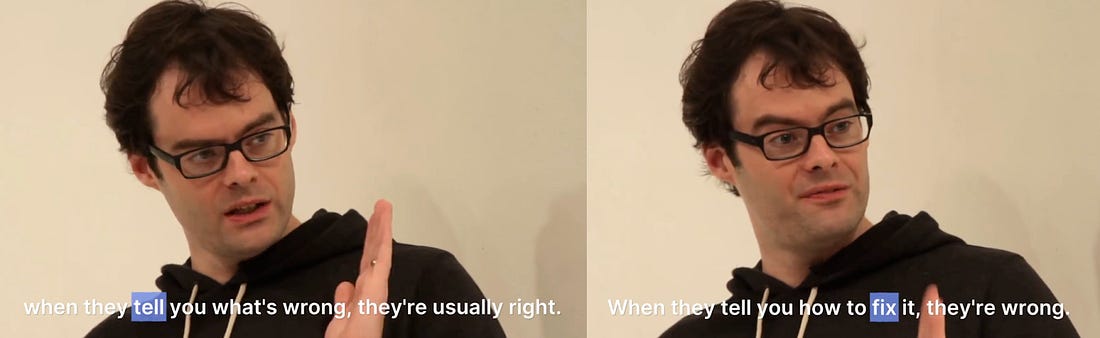
Here’s a template I use: When it comes to the questions, the best approach is to pick a specific area but ask for their general take or mental model. Don’t ask them how to solve a specific problem – you’ll never give them enough context and they’ll feel obliged to say something anyway. People are nice and don’t want to say “you have to figure that out for yourself.” The person I am talking to may have already spoken about these topics in an article they wrote or an interview they did, but I don’t worry about that. If I’m trying to get in touch with someone because they were on Lenny’s Podcast, they are probably too busy/famous to talk to me anyway! Start closer to homeIf it’s an option, your own team can be a great source of advice! For example, I went through a period of interviewing every new sales hire about a month after they joined PostHog to get as much specific, detailed information out of them. Here’s a template you can use: You don’t really need to have a specific agenda – I find these conversations less good for solving specific problems, and better for casting the net wide and seeing what you find. For example, we didn’t watch sales call recordings early on – we’re too busy selling to watch calls! But Scott convinced me that this is actually extremely important at any stage – “there isn’t a basketball team that doesn’t watch recordings of how they play.” (This is probably why I suck at basketball right?) Diagnoses > solutionsStatistically speaking, the person giving you advice is not going to nail the solution every time. In fact, they’ll probably be right 50% of the time. If you get two people giving you conflicting advice, the number of correct opinions is either 0 or 1. They will however be pretty likely to nail the problem you’re facing, because there are exponentially more potential solutions than there are problems, and problems tend not to vary as much over time. Everyone is dealing with how to hire, fire, manage, pay, acquire customers, retain customers, etc. For example, I spoke to three companies who all agreed that relying on solely inbound sales won’t scale beyond a certain point, and you need to figure out outbound before you actually need it. However, one suggested hiring a senior BDR, another a go-to-market engineer, and the other an account executive who could do BDR experiments. We’re solving this with the first option, because that makes the most sense in the context of our business, customer base, and existing systems. It’s a meme, but 80% of figuring out the right solution is getting to the root of the actual problem first. Don’t underestimate the role of luckOne thing you should always ask yourself is “how much can I attribute this person’s success to their brilliance vs. external factors such as luck?” We love a good Napoleon or Caesar biography where their success is attributed to a series of extremely smart decisions made after a period of intense contemplation, but the reality is that a lot of anybody’s success is down to a specific time/place/economy/environment/weather. Many of our best decisions weren’t the result of deep, careful thinking – they were vibes that turned out to be right because that’s the way the wind was blowing. And we’ve got plenty of things wrong anyway that came after a bunch of analysis.
Getting advice from someone who has only worked at Google, Meta, and Netflix mayyy be helpful because they’ve probably worked with a lot of excellent people, but remember that you’ll be trying to apply lessons from some of the biggest outliers in history to your situation. I think the best way to figure out whether the person is brilliant or lucky is gut feel:
If it’s the latter in both cases, the advice won’t necessarily be bad, but they might have been more lucky than good. Words by Charles Cook, who is currently working on a billboard campaign around the slogan “what doesn’t kill you makes you PostHog” Subscribe for more advice. 🦔 Jobs at PostHogReally, the best advice I can give you is to join us, we’re hiring these roles and more: 📚 More good reads
|







Similar newsletters
There are other similar shared emails that you might be interested in: