Travel Tech Essentialist #196: Rebundling
- Mauricio | Travel Tech Essentialist <traveltechessentialist@substack.com>
- Hidden Recipient <hidden@emailshot.io>
A lot of what looks like disruption is really rebundling. AI is reshaping which tasks belong to which roles. Airlines are rewiring how they create demand. Solo living is restructuring who travels and how. And capital is quietly shifting to different parts of the hotel stack. The bundles we took for granted are being taken apart and reassembled. Special thanks to Propellic for sponsoring this edition of the newsletter:
1. First-principles-driven tech trendsContrary’s 2026 Tech Trends Report is a dense but sharp read on where value may accrue in the next cycle. The report groups the future into a few major waves: smarter AI (especially specialized agents), cheaper and more powerful computing, frontier technologies becoming real industries, and a new phase in medicine and healthcare innovation. The analysis stays close to first principles. Rather than listing gadgets, they focus on how changing cost curves, data moats, and infrastructure bottlenecks will shape durable advantages. It’s a useful lens for thinking about which parts of the stack are becoming commodities versus where new defensibility might emerge. What I appreciate about this report is that it treats “trends” as deep, slow-moving technology currents rather than surface-level vibes and consumer fads. It starts from foundational shifts in AI, compute, industrialization, and healthcare, then traces how behavior and business models will reorganize around them. That kind of first-principles lens is far more useful for travel than yet another list of hot destinations and trendy travel buzzwords, because it helps you see where value, power, and constraints in the broader tech stack are heading. On transportation and mobility, the report argues that the real action is under the consumer layer: logistics orchestration, autonomy-ready infrastructure, and electrification. The advantage won’t be another slick booking front end. It will be control over how routes are optimized, who gets access to capacity, and who owns the underlying data. 2 The autonomous car risk-perception gapAn interesting section in Contrary’s Tech Trends Report is the gap between how safe driverless cars are and how safe they feel. Only 13% of US survey respondents say they trust autonomous vehicles; a clear majority remain afraid or unsure, despite millions of miles driven by autonomous vehicles now on the road. Waymo passed 100 million fully driverless miles in July 2025 and shows 80–90% lower crash rates than human drivers across Phoenix, San Francisco, Los Angeles, and Austin, depending on the metric. The authors estimate that if all US vehicles operated at Waymo-like safety levels, the country could prevent roughly 37,000 deaths per year and save around $1 trillion in societal costs. Behavioral scientists would call this a risk‑perception gap; people anchor on rare, vivid incidents and headlines rather than the boring, statistical base rates. A media environment focused on AI-doomer narratives amplifies every driverless-car crash while largely ignoring the thousands of routine road deaths that happen every week. That distortion is also an opportunity for whoever can convert invisible safety into felt safety through product design, onboarding, transparency, guarantees, and narratives that make the math legible.
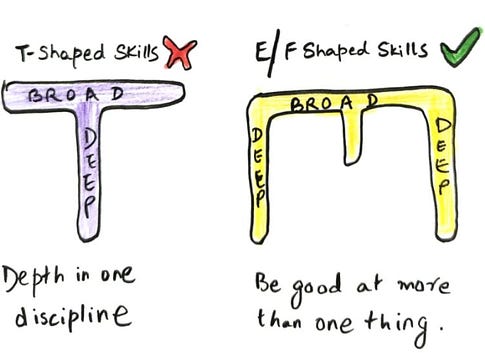
3. The Mexican standoff of rolesIn a recent podcast with Lenny Rachitsky, Marc Andreessen described a “Mexican standoff” among PMs, engineers, and designers. His point was that with modern AI, each role now plausibly believes it can do the others’ jobs. Engineers think they can PM and design, PMs think they can design and code, and designers think they can code and PM; and they’re all a little bit right. Underneath the joke is a serious career reframing. A “job” is just a bundle of tasks, and AI is rapidly rebundling who does what. Instead of asking “Will PM/engineering/design survive?”, the better question is: which tasks in my bundle get automated, and which new ones can I pick up? This task rebundling is not new. Fifty years ago, a CEO dictated memos and an assistant did the typing and distribution; today, executives write their own emails, while assistants focus on higher‑leverage coordination and orchestration. 4. From T‑shape to F or E-shapeMarc highlights the opportunity to become a super‑powered individual. His advice starts with the classic T‑shaped idea: go very deep in one discipline, then build enough breadth across adjacent ones to collaborate intelligently. AI supercharges that model. You keep one serious spike, say engineering, but now have leverage to add PM and design skills across the top of the T without starting from zero each time. Then he pushes it further. Instead of a single vertical and one horizontal bar, he imagines something closer to a sideways F or E, with multiple deep spikes, not just one. Scott Adams’ Dilbert only worked because he combined being a decent cartoonist with real business experience; Hollywood “auteurs” stand out because they can both write and direct; Taylor Swift is powerful not just as a singer but as a singer‑songwriter who also architects her brand and tours. The pattern is the same; rare combinations compound, they don’t just add. In an AI world, the goal is not to be just a PM, engineer, or designer, but to be unusually strong in at least two of them, with AI filling in the rest of the stack. 5. What airlines can learn from fashion retailersThe most interesting airline ideas could be in rewiring how demand is shaped. In a recent piece, JoseLuis Vilar (Caravelo co-founder) argues that some airlines no longer need seasonal sales because they have quietly embedded Zara‑style behavioral mechanics into their business model through subscriptions. He highlights four principles of sales psychology that make Zara’s sales powerful: predictability, pre‑commitment, privileged access, and ritual, and shows how travel subscriptions deliver all four on a permanent basis. Instead of waiting for a January sale, subscribers know exactly when their flight quota refreshes each month, and the data he shares shows the median time from signup to first booking is under two days. They stop spending five hours and 141 page views per trip hunting (Expedia’s average) and start planning around a known rhythm and airline. The kicker is that most of this demand is incremental. Across Caravelo partner airlines, only a minority of subscription flights cannibalize trips passengers would have taken anyway; the majority are either new trips or share‑shift from competitors. Subscriptions turn “looking around” into “using what I already paid for,” shifting the game from price competition in metasearch to competing on access, control, and cognitive offload. 6. When funders leaveMatt Lerner’s post about PayPal illustrates what happens when leadership loses its founder mentality. The inflection point came after the eBay acquisition; the founders left, former consultants and MBAs took over, and asset allocation thinking filled the organization. Of course, the travel industry is not immune to this phenomenon. Lerner’s biggest wins came from unsexy work like fixing onboarding, tightening referral loops, and A/B‑testing service to reduce churn, all of which generated hundreds of millions in ARR with essentially no extra ad spend. Yet it became easier to get more budget for paid acquisition than to get engineers to fix the funnel. Departments began prioritizing their own P&L over customers. The focus shifted from solving customer problems to managing internal budgets. When more energy goes into “spending money” than into removing bottlenecks, the post-founder decline phase has usually begun. 7. Intensity as a founder’s strategyThat’s why a recent My First Million podcast about NBA owner and mortgage billionaire Mat Ishbia feels like the mirror image. Ishbia describes walking the floor of his thousands‑person company every day, talking to everyone from sales reps to IT, looking for three problems and fixing them on the spot. Over a year, that is roughly a thousand bottlenecks removed. The hosts call this “intensity as the strategy”; combining a simple, sharp thesis with obsessive attention to the details that block it. Founders live on a day-to-day contract with themselves; there is no guaranteed five-year, $150 million deal regardless of performance. Set against Lerner’s account of PayPal, the contrast is clear. Healthy companies still look like Ishbia’s daily floor walk, not like a budgeting meeting centered on how much more can be spent. 8. Travel & Hospitality Tech market updateAGC Partners just released its data- and insights‑rich “Travel & Hospitality Tech Market Update” for Q4 2025, showing where money and power are moving in travel tech. The report shows Travel & Hospitality Tech shares have grown roughly 2.8x since 2019 with expanding margins, and argues that investors are rewarding “quality growth” far more than raw profitability. A few key points:
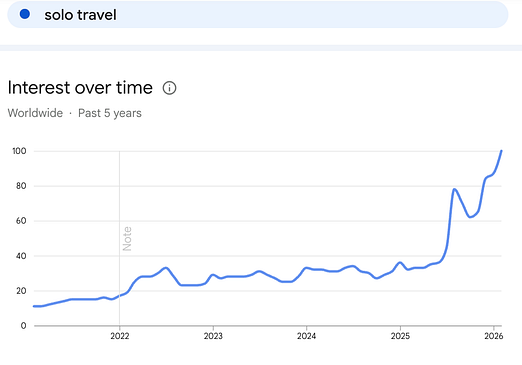
If you want a grounded view of how investors are pricing travel tech, who is buying what, and where capital is flowing within the stack, this deck is worth reading. 9. Solo travel seems to be more than a “trend”Google searches for “solo travel” were flat from 2021 through 2024. Then something shifted. Starting in late 2024, interest spiked, and by early 2026, searches hit record highs.
The spike maps to a deeper behavioral shift. There has been an uptick in time spent alone, particularly among younger people, though it is present in all age groups (see first image below). Activities done alone (such as gaming, social media, eating and drinking…) have surged. Social activities like walking with others or playing with children have declined (see second image below).  The first chart shows time spent alone increasing across age groups. The second one highlights the rise in solo activities and the decline in social ones. Source: Contrary Lennart Dobravsky recently highlighted a striking data point: 29% of US households now consist of just one person, the highest share ever recorded, according to Apollo Global Management. That's 40 million Americans living alone. The travel industry has not paid enough attention to this structural change. Solo travelers don’t need “singles cruises” or awkward mixer events. They need pricing that doesn’t penalize them, booking flows that don’t assume a “+1”, experiences that are also designed for one and restaurants that don't relegate them to the worst table by the kitchen or serve only shareable plates. 8. Travel tech job market insights 2025I analyzed more than 10,000 active roles and thousands of candidate clicks and applications from the Travel Tech Essentialist job board. For this analysis, “engagement” refers to candidate actions on listings, primarily clicks and applications. A few clear patterns emerged:
I break down the full analysis here. Travel Tech Essentialist Job Board→ Explore all 1770 open roles on the Travel Tech Essentialist Job Board now.
Search jobs by seniority → Internships (48 jobs) 📩 For monthly updates on the latest roles, subscribe to the Travel Tech Jobs newsletter If you like Travel Tech Essentialist, please consider sharing it with your friends or colleagues. If you’re not yet subscribed, join us here: And, as always, thanks for trusting me with your inbox. Mauricio Prieto
|







Similar newsletters
There are other similar shared emails that you might be interested in: