Building Trust and Credibility is the New Moat for Engineering Leaders
- Gregor Ojstersek from Engineering Leadership <gregorojstersek@substack.com>
- Hidden Recipient <hidden@emailshot.io>

Hey, Gregor here 👋 This is a paid edition of the Engineering Leadership newsletter. Every week, I share 2 articles → Wednesday’s paid edition and Sunday’s free edition, with a goal to make you a great engineering leader! Here are some of the recent popular paid articles you might have missed: Building Trust and Credibility is the New Moat for Engineering LeadersIt's more important than ever to be considered trustworthy, especially to the leadership team and stakeholders. This is how to do it!
IntroWe hear the word “moat” a lot these days, especially in the context of AI. “Good judgment is the new moat for engineers”. “Harness is the new moat for AI products”. “Loop engineering is the new moat”. So, in the spirit of a trending word, I’ll be sharing what I believe is the new moat (competitive advantage) for engineering leaders in this article. The insights are based on what I am hearing and seeing regularly from talking with different engineers and engineering leaders across the industry, and what I recommend they do in order to become valuable at their company and grow in their careers. This is an article for paid subscribers, and here is the full index: - This is the situation that I’ve seen happening now quite a few times Let’s start! This is the situation that I’ve seen happening now quite a few timesThis is a fictional example, but imagine you are a CTO or a VP of Engineering of a mid-size company. The CEO, or some other C-suite leader, happens to hear about a new AI tool or reads a certain blog post about a specific approach that would 10x the engineering productivity. There are 2 options on what happens next.
Option 1 is totally fine, and I definitely recommend that CEOs and other C-suite members be curious and look for what may be a good opportunity for the organization. But the problem comes with option 2. They don’t consult with the engineering leader to determine whether that tool is actually worth it, they just start with the adoption process. They set up all the meetings and start the initiative. After it’s already in progress, and everyone is talking about it, they call the engineering leader in the room to just align on the details of the execution. That’s unfortunately where it’s too late for the engineering leader to have a say, whether it’s actually worth it or not. They are just expected to own the implementation with the expectation of engineering productivity to increase drastically. And that’s the problem. As an engineering leader, you shouldn’t be “looped in” to a new AI initiative, you should be the one who is owning that initiative. And the reason why you are not owning it is the lack of trust and credibility. You haven’t made yourself trustworthy enough to have a say in whether the tool is even needed or not, which is a huge issue and can hurt you a lot in your role. Another situation that happens on a team levelYou are either a Tech Lead (Staff), Team Lead, or an EM leading the team. Your Director of Engineering comes back from a conference and is hyped by all the engineering productivity gains they hear that other companies have accomplished. They might also be pressured by the leadership team to show a higher productivity increase in their teams. You’ve been telling them that you and the team are trying everything they can to find productivity improvements with AI tools, but because of the complexity of the codebase and the nature of the work (infrastructure), the productivity increases are not that high, and you can’t just blindly trust AI-generated code, as the work is very critical to ensure the stability of the services. There are 3 options on what happens next.
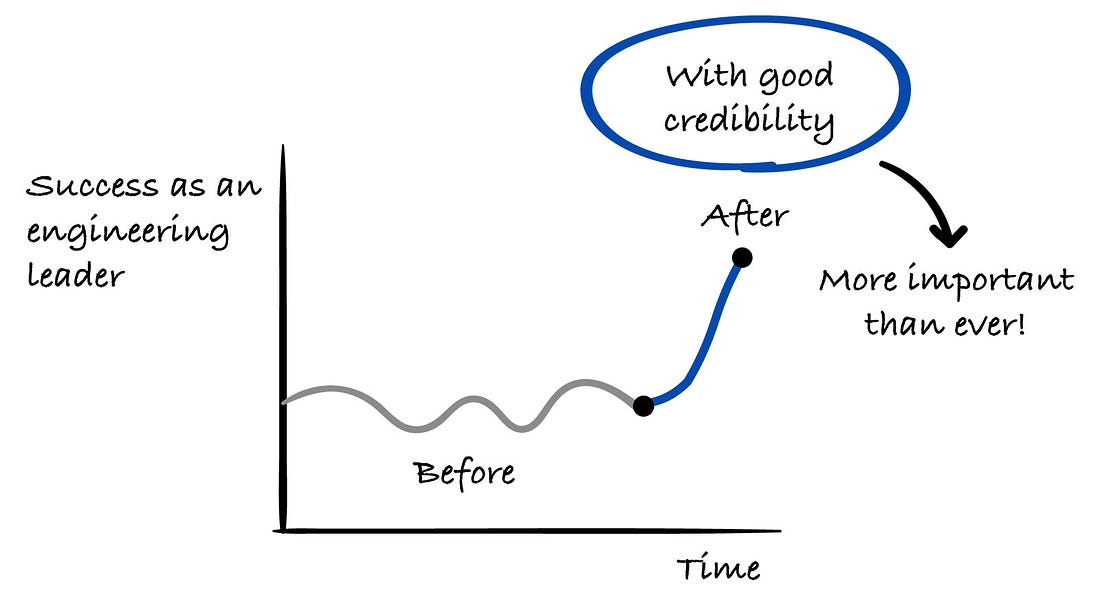
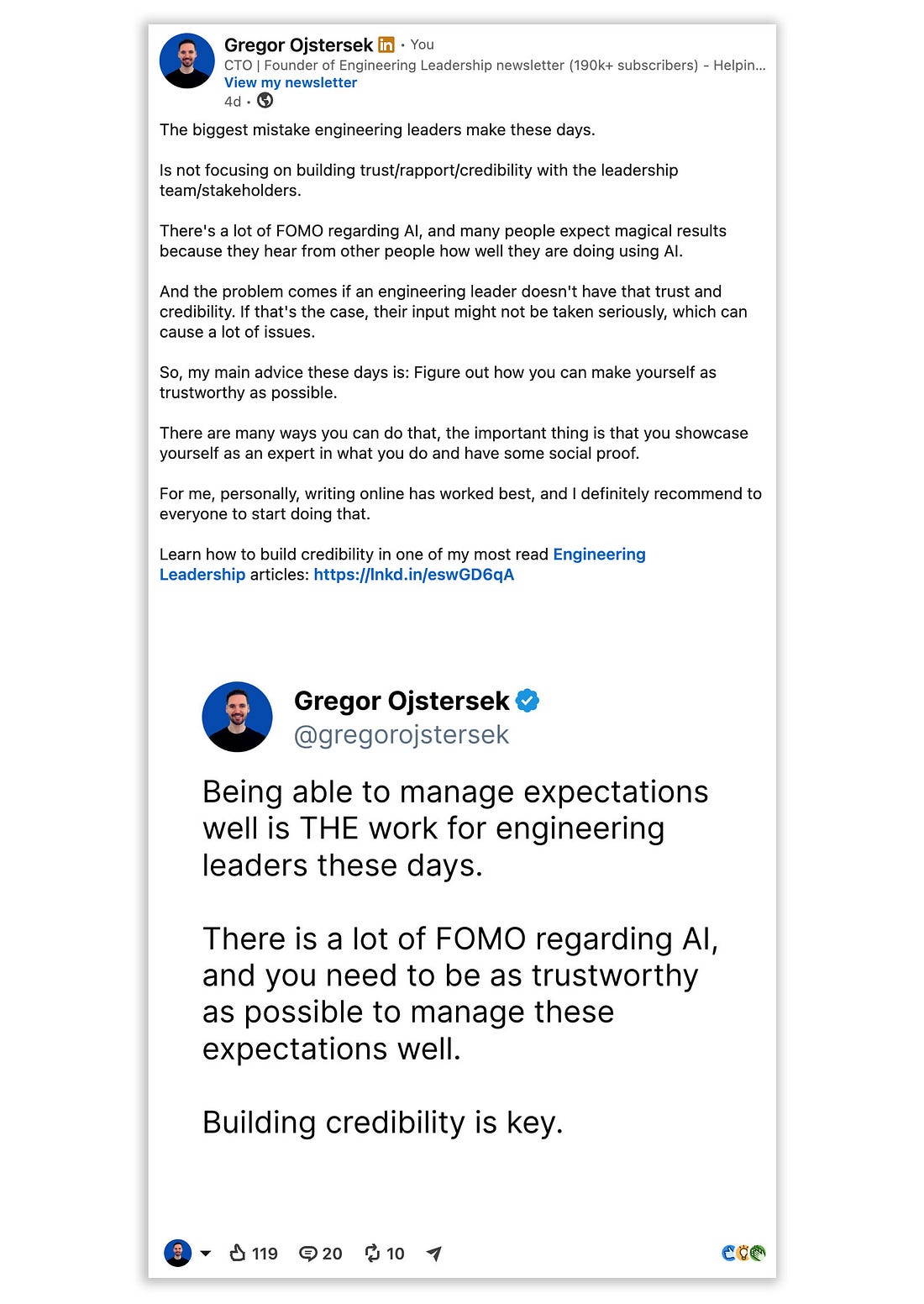
The first option is where you want to be, and where your word has weight. But with options 2 and 3, you might have quite an issue, and the main reason, again, is credibility and trust. They don’t trust you enough that your word has weight and that you mean to do the right things for the organization. This can be quite an issue if you don’t improve in this area. Being able to manage expectations well is becoming THE job of engineering leadersAs both examples above have illustrated, there’s a lot of pressure on people to showcase “magical results” with AI, since many people are experiencing FOMO regarding AI, because they hear from other people how well they are doing using AI. And the problem comes if you, as an engineering leader, don’t have that trust and credibility. If that’s the case, your input might not be taken seriously, which can cause a lot of issues for you and your team.
This can single-handedly solve so many issues for you as an engineering leader, and of course, this is a big competitive advantage that’ll help you grow in your career. There are many ways you can do that, the important thing is that you showcase yourself as an expert in what you do and have some social proof. For me, personally, writing online has worked best, and I definitely recommend it to everyone to start doing that. Now, let me share in detail on what you should do to become trustworthy and build credibility, so your word has weight, which is crucial at this time! As mentioned, this can be the difference in having a great time in your role and being a candidate for promotion, or you stagnate and be a potential candidate for replacement. How to build credibility and become trustworthy?...Subscribe to Engineering Leadership to unlock the rest.Become a paying subscriber of Engineering Leadership to get access to this post and other subscriber-only content. A subscription gets you:
|





Similar newsletters
There are other similar shared emails that you might be interested in: