The Sequence Radar #828: NVIDIA’s GTM Releases, Bezos’s $100B Bet, Xiaomi’s Ambush, and the Fracturing of OpenAI
Was this email forwarded to you? Sign up here The Sequence Radar #828: NVIDIA’s GTM Releases, Bezos’s $100B Bet, Xiaomi’s Ambush, and the Fracturing of OpenAINews from NVIDIA's GTC, model releases and more.
Next Week in The Sequence:
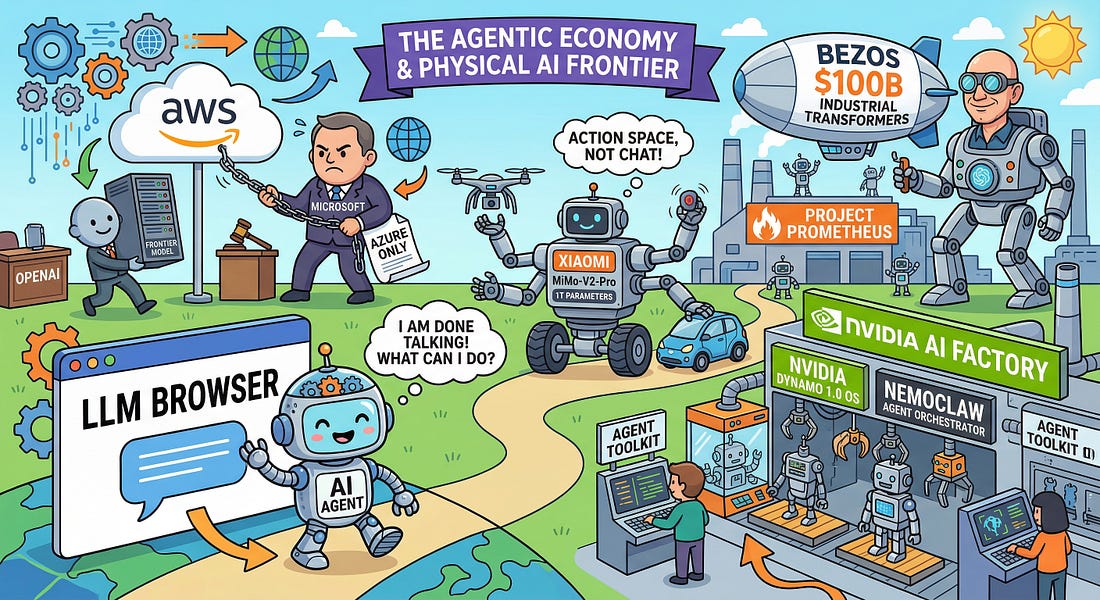
Subscribe and don’t miss out:📝 Editorial: Last Week in AI: NVIDIA’s GTM Releases, Bezos’s $100B Bet, Xiaomi’s Ambush, and the Fracturing of OpenAIThis week in AI feels like a definitive inflection point. We are no longer just talking about chat interfaces and reasoning benchmarks; the industry is aggressively pivoting toward agentic infrastructure and physical world integration. From Silicon Valley to Beijing, the narrative has shifted entirely from “what can AI say?” to “what can AI do?” Nowhere was this paradigm shift clearer than at NVIDIA GTC 2026. While hardware updates are always a staple, Jensen Huang’s keynote made one thing unequivocally clear: NVIDIA is now a software and infrastructure company. The spotlight was stolen by their agentic software announcements, most notably Dynamo 1.0—an open-source distributed operating system for AI factories—and NemoClaw, an enterprise stack designed to build and orchestrate self-evolving agents. By integrating these with the new Agent Toolkit, NVIDIA is positioning itself as the foundational orchestration layer for the agentic economy. They aren’t just selling the silicon anymore; they are building the entire nervous system for enterprise AI. Meanwhile, the frontier model race saw a “quiet ambush” from the East. Xiaomi stunned the global AI community with the release of MiMo-V2-Pro. Boasting 1 trillion parameters and a massive 1-million-token context window, the model rivals the performance of GPT-5.2 and Claude Opus 4.6 at a fraction of the inference cost. But what makes MiMo-V2-Pro truly fascinating is its design philosophy. Rooted in Xiaomi’s deep consumer hardware and EV pedigree, the model is engineered specifically for the “action space.” It bypasses the traditional conversational paradigm, built instead to act as the brain for digital workflows and physical robotics. The moat around US-based frontier models is rapidly evaporating. Further cementing this push into the physical world, Jeff Bezos is reportedly raising a staggering $100 billion fund to acquire and overhaul legacy manufacturing, aerospace, and defense companies. Dubbed a “manufacturing transformation vehicle,” the fund will leverage technology from Bezos’s own spatial AI startup, Project Prometheus. The goal is bold and disruptive: to fundamentally rewire global industrial supply chains by replacing human dependency on the factory floor with spatial and physical AI. It is a massive bet that spatial AI will do to manufacturing what LLMs have done to knowledge work. Yet, as the technology scales into the real world, early corporate alliances are fracturing under the weight of astronomical compute demands. The foundational partnership of the AI boom is currently on the brink of a courtroom battle. Microsoft is reportedly threatening to sue OpenAI over a multi-billion dollar deal to host OpenAI’s upcoming “Frontier” model on Amazon Web Services (AWS). Microsoft argues this violates the spirit of their Azure exclusivity agreement, while an increasingly independent OpenAI is desperately scrambling for the raw compute capacity required to stay ahead. From NVIDIA’s agentic operating systems and Xiaomi’s hardware-brained LLMs to Bezos’s industrial buyout fund and the Microsoft-OpenAI fracturing, this week offered a stark glimpse into the next era of artificial intelligence. The models are stepping out of the browser and into the factory, the data center, and the courtroom. 🔎 AI ResearchEfficient Exploration at Scale
EvoClaw: Evaluating AI Agents on Continuous Software Evolution
MetaClaw: Just Talk – An Agent That Meta-Learns and Evolves in the Wild
Online Experiential Learning for Language Models
Efficient Reasoning on the Edge
Recursive Language Models Meet Uncertainty: The Surprising Effectiveness of Self-Reflective Program Search for Long Context
🤖 AI Tech ReleasesAgent ToolkitNVIDIA released its Agent Toolkit, a new agent development platform. NemoClawNVIDIA announced its enterprise-ready version of OpenClaw for semi-autonomous agentic workflows. ForgeMistral released Forge, a new platform that allows enterprises to train their own models. MiniMax M2.7MimiMax open sourced M2.7, its new model optimized for agentic workflows. 📡AI News You Need to Know About
You’re on the free list for TheSequence Scope and TheSequence Chat. For the full experience, become a paying subscriber to TheSequence Edge. Trusted by thousands of subscribers from the leading AI labs and universities.
|






Similar newsletters
There are other similar shared emails that you might be interested in: