Travel Tech Essentialist #194: Structural Shifts
- Mauricio | Travel Tech Essentialist <traveltechessentialist@substack.com>
- Hidden Recipient <hidden@emailshot.io>
Much of the noise in travel tech focuses on short-term moves: funding rounds, launches, partnerships, product tweaks. Some of the stories in this issue look at what’s moving underneath. From AI reshaping how discovery and decisions happen, to new frameworks for growth, to long-cycle shifts like agent-led commerce and the quiet return of reviews as infrastructure. These are changes likely to reshape how the industry works. Special thanks to Propellic for sponsoring this edition of the newsletter:
1. I ran Lenny’s podcast through an LLMLenny Rachitsky is a writer, investor, and host of one of the most popular product and growth podcasts. I ran Lenny’s 320 podcast episodes through an LLM to pull out insights especially useful for travel tech founders and entrepreneurs. Here are three that stood out:
2. New: Travel product & growth co-pilot, powered by Lenny’s PodcastI just released a new ChatGPT agent built for travel founders, operators, and execs. Try it here. It draws from all 320 episodes of Lenny Rachitsky’s podcast and is designed to help you apply the best product and growth thinking to travel-specific problems, from onboarding and activation to PMF, retention, and go-to-market. It’s free to use and open to anyone building in and around travel. Would love feedback if you give it a spin.
I asked it whether I should launch a generalist OTA. It gave a reasonable, nuanced, and well-argued answer. Short version: almost certainly no. Longer version: read it here. 3. Travel’s zombie narrativesIf you’ve been reading travel news long enough, you start to see the loop. I say this with some guilt as I’ve echoed a few of these myself. There’s the eternal Ryanair vs. eDreams feud; Michael O’Leary hurling “digital pirate” insults while an always unnamed eDreams exec issues a legal rebuttal no one reads past the second sentence. The Direct vs. OTA rivalry resurfaces every few months too, complete with “best rate guarantees,” assuming the guest remembers their loyalty number from three phones ago. Then comes the Google Travel cycle, where OTAs spend billions outbidding each other in an ecosystem they call unfair. Every year, someone declares independence, only to quietly raise their ad spend a few weeks later. The Super App prophecy returns next, while last quarter’s “super” quietly gets sunset. Spring brings the Sustainable Travel Pledge. Q2 earnings quietly make it disappear. Lately, the new zombie headline is AI ending metasearch or OTAs. It pops up every time someone demos a travel chatbot or flight tool, framed as the latest “existential threat.” The tech shifts, but the “end-of-an-era” script doesn’t. And then there’s the “Brussels will fix it” arc. Offstage, the EU drafts another rulebook and billion-euro fines for “gatekeepers” and “unfair platforms” (almost always American), with promises to restore balance. A year later, the fines are priced in, the lawyers are paid, and the biggest players have turned compliance into a moat. Travelers foot the bill through higher prices, clunkier UX, and the products that never get built. It’s a carousel of déjà vu headlines and recycled fights. If a story promises “the end of something,” a “revolution,” or “a new era of booking,” you can probably skip it. The ones worth your time aren’t on repeat.
4. Five clear rules for building in 2026This deck from Megan Lightcap and the Creator Fund team highlights five clear principles for building trust, distribution, and staying relevant, especially in a crowded market where AI makes it harder to stand out.
5. McKinsey hires a creator economy advisorMore companies are starting to treat creators not as a marketing tactic, but as part of their core distribution strategy, including the ones you wouldn’t expect. Monica Khan, a former YouTube and Meta executive, has joined McKinsey as a senior advisor focused on the creator economy. She’ll work with Fortune 500 clients across media, tech, and consumer to build creator-led strategies for growth, go-to-market, and brand. She’s also helping build internal frameworks that shift enterprises away from one-off influencer campaigns toward long-term systems where creators act as partners in trust, storytelling, and distribution. McKinsey making a dedicated creator economy hire is a clear signal that creators are no longer just a side channel and should increasingly be treated as strategic partners and operating infrastructure for trust and distribution. 6. Google’s UCP: Agentic commerce comes for distributionGoogle just announced the Universal Commerce Protocol (UCP), a new open standard that lets AI agents communicate with retailers, payments, and loyalty systems throughout the entire shopping journey, from discovery to checkout and post‑purchase support. In practice, it is an attempt to standardize how “agentic commerce” works so that agents can plug into Shopify, Walmart, Target, etc., without custom integrations every time. The interesting bit is that UCP shows up directly in Google’s AI surfaces during checkout, using payment credentials already stored in Google Pay, with the retailer still the seller of record. That is Google moving one step closer to owning the intent, the interface, and now a clean hand‑off to transaction, without having to run the inventory or the risk. Two travel‑relevant takeaways:
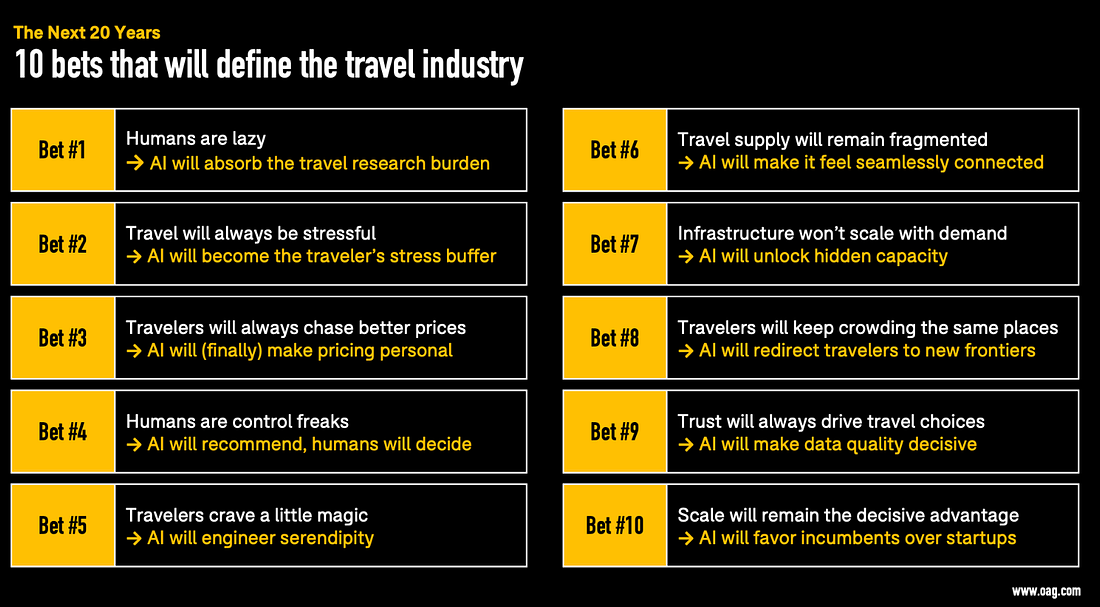
The rails for agent‑mediated distribution are being laid right now, and they’re being laid by the same players that already sit closest to demand. In consumer internet, the uncomfortable truth is that it’s rarely the “best” product that wins; it’s the product riding the strongest distribution rails. Google’s UCP is an attempt to lay those rails for agentic commerce. If you’re building anything that depends on owning the customer relationship, you need a view on whether you integrate into these agentic rails, try to compete with them, or design around them altogether. 7. Travel in 20 yearsInstead of asking what will happen in 2026, OAG’s Travel 2045 report asks “Where will travel be in 20 years?” That long view forces sharper questions. What systems are becoming obsolete? What labor, infrastructure, and data dependencies are quietly breaking? Which categories haven’t been invented yet? The report opens with a look back at five defining shifts from 2005 to 2025 and then offers ten long-range bets for what comes next. It frames this moment as a once-in-a-generation transition, one where autonomous systems begin making more of the decisions travelers used to make themselves.
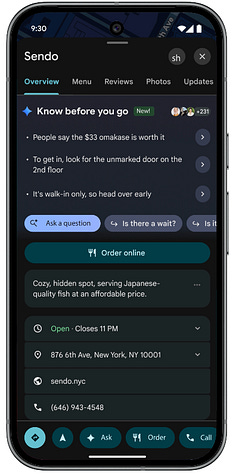
8. Google Maps moves deeper into travel adviceGoogle is rolling out a new “Know Before You Go” section in Maps, a feature that surfaces practical, context-specific tips for places like restaurants, hotels, and venues. Powered by Gemini, it pulls from reviews and online content to answer questions travelers often ask too late: Is there parking nearby? What’s the dress code? Is there a secret menu? Read + One implication is that reviews are making a comeback. As AI models rely more on real-world experiences to generate recommendations, the substance of those reviews starts to matter again. Not just the star rating, but the details, patterns, and context they contain. Another step in Google Maps evolving into a real-time travel assistant, one that learns from what people actually say, not just what places claim to offer.
9. “Since when is life about happiness?”When Dara Khosrowshahi was offered the Uber CEO job, he told his friend Daniel Ek (the founder of Spotify) that he was happy running Expedia. Ek responded: “Since when is life about happiness? It’s about impact.” [source]. That single line captures a mental model many founders quietly operate with but rarely articulate. Ek frames happiness as a trailing indicator of impact. You define the game, the arena where you want to matter, and happiness follows from doing consequential work there. In Dara’s case, Ek sensed he was “content, not happy”; he had largely solved the “Expedia puzzle”, life was easy, and that ease was a warning sign. Uber was a mess; chaos, regulation, and a chance to shape how cities work. Two nuances are worth highlighting. “Impact” is personal and highly idiosyncratic. For another friend, Ek says he might give the opposite advice. “Go for greatness” is more a question than a universal command. Is the game you’re playing still worthy of your next decade? For founders, that’s a useful litmus test before the next raise, pivot, or exit conversation. 10. Dara Khosrowshahi: impact, measured in market capIf Ek’s question to Dara was about upgrading the game he was playing, the market has since kept score in a very public way. The contrast between Dara’s Expedia chapter and his Uber chapter is, in many ways, what impact looks like when it shows up as market cap. At Expedia, he took over a $4–$6 billion business in 2005 and left in 2017 with a company worth around $20 billion. That growth came from a decade of roll-ups, supply-side integration, and a relentless focus on turning a fragmented OTA landscape into a scale game, which made Expedia one of the two dominant global online travel agencies. At Uber, he walked into a cultural crisis: heavy burn, broken culture, and no clear path to profit. The private valuation in 2017 was around $76 billion. Today, it’s about $179 billion. That’s more than $100 billion in public-market value added during his tenure. It’s not the only way to measure impact, but in Dara’s case, the scoreboard at Uber shows he stabilized a broken company and added over $100 billion in market value. Travel Tech Essentialist Job Board→ Explore all 1475 open roles on the Travel Tech Essentialist Job Board now.
Search jobs by seniority → Internships (27 jobs) 📩 For monthly updates on the latest roles, subscribe to the Travel Tech Jobs newsletter Fundraising? Submit your startup to the Travel Investor NetworkIf you’re raising a round (pre-seed to Series D), complete your profile on our new platform. We’re partnering with Pynn, an AI-powered platform to better evaluate startups and manage deal flow. It takes about 5 minutes to complete and helps investors assess opportunities more efficiently. We review every submission. Even if we don’t follow up directly, your profile may still be discovered by relevant investors. Travel investors (VCs, corporates, angels): If you are interested in joining the Travel Investor Network, please request an invite by completing this form (should take less than 2 minutes). If you like Travel Tech Essentialist, please consider sharing it with your friends or colleagues. If you’re not yet subscribed, join us here: And, as always, thanks for trusting me with your inbox. Mauricio Prieto
|







Similar newsletters
There are other similar shared emails that you might be interested in: