In today’s newsletter: GPT-6 Astra edited two layers of Qwen and raised its MATH-500 score from 7.9% to 48.1%. We look at the loop Qwen kept getting stuck in and the hint the MIT team’s prompt gave Astra. Plus, which new models you can try this week and how a model trained on words can learn the same patterns as one trained on images. |
|
| | | | This Week in Turing Post: | Friday, November 6 / AI 101: Looped Transformers: A broad perspective Sunday, November 8 / Twitter Library: Computer-use agents update
| |
| |
|
| | | | Today’s editorial: When One AI Edits Another’s Weights | | | When I saw the reactions like these, I put aside the editorial I had planned and decided to investigate what’s happening. | Well, today, November 2, researchers at MIT CSAIL published Sparks of Weight-Space Programming. Within hours, their announcement had passed a million views on X. One reader called it “model on model surgery.” | Why did it blow up so fast? Partly because the phrase itself sounds like sci-fi: one AI acting as a surgeon, opening up another model's brain to rewrite its circuitry. They are alive and acting! Throw in a headline metric like a 7.9% to 48.1% leap on MATH-500, and that’s it. We arrived at AGI station with full-on RSI. | Yet the concept behind it isn't an overnight revelation. The broader research direction has been building for years: researchers have been exploring model editing, weight-space representations, and hypernetworks long before this paper. The real surprise was how the demonstration was staged. | The first thing I want to show you is the Breakout paddle. | The team gave GPT-6 Astra the weights of a small game-playing network as text. (Weights are the numbers that training adjusts to help the network choose its next move.) Astra got all 17,253 of them, plus a description of the grid and controls. Could it name the game without a list to choose from? | In the map on the left, the strongest connections for the player’s position sit along the lowest playable row. A paddle could move left and right there. Astra considered Pong, too, but look at the map on the right. Those three rows of reward targets near the top give the bricks away. Astra guessed Breakout without seeing a single frame. | | Reading weights is one half of the equation. For the writing half, they asked Astra to make another language model, Qwen3.5-0.8B, better at math. Astra had Python, practice problems, and up to 50 batched tests to try out edits. The team ruled out retraining and kept the test questions private. | With its optional thinking mode on, Qwen kept repeating steps it had already written. Astra compared Qwen’s internal signals during those loops with the signals from steps where it made progress. It found that two layers, 15 and 19, reinforced a pattern associated with repetition. To weaken it, Astra made an edit touching 131,072 weights, about 0.016% of the model. On MATH-500, Qwen’s accuracy went from 7.9% to 48.1%. | | Coauthor Alex Zhang says the team initially thought Astra had somehow edited a new math skill into Qwen. Look at how the answers ended, though. Before the edit, 93% hit the length limit. Afterward, 33.1% did. Much of that sixfold gain came from Qwen finally finishing problems it could already solve. The team also tried Gemma 3 270M, which generally finished its answers but made mistakes in arithmetic and algebra. Astra’s edits produced no clear gain there. | Did you notice that we mentioned the loop? Because that loop is where the viral narrative gets grounded by truth. | So who spotted the loop? Researcher Lucas Beyer read the prompt. (Here is the full prompt.) It explicitly told Astra that if Qwen “repeats itself and never finishes, finding and fixing what drives that repetition counts.” Qwen’s own documentation had already flagged this behavior. | Coauthor Jayden Teoh replied that the team had given its short assignment to Claude Code. He said Claude Code added the hint as it expanded the prompt, without further human feedback. I’m glad Beyer asked. One model suggested where to look, and another figured out which of Qwen’s 800 million weights to change. | Model cooperation the media hasn't hyped yet! | The prompt changes how you read an “AI will kill us” headline, too. Vidhay Reddy told CBS he was asking Gemini how to prevent elder abuse when it told him to die. Transluce researchers later cited his case while deliberately looking for prompts that could get models to encourage self-harm. | Weight editing itself has a clear lineage. Techniques like ROME, MEMIT, and task arithmetic showed years ago that parameters hold direct associative structures you can steer. In 2024, researchers used related targeted edits to control when chatbots refuse a request (Refusal in Language Models Is Mediated by a Single Direction.) | What makes this paper compelling – and what drove that million-view surge – is the orchestration: describing a high-level problem in plain English, handing an off-the-shelf foundation model an execution harness, and letting it systematically probe, isolate, and patch another network's weights. | The team even tried a shorter prompt without the example about repetition. With 25 batches of tests, Qwen reached 14.1% accuracy after editing, the same score as in the run with the hint. The table has no 50-batch result for that shorter prompt. That’s the row I’d love to see. |
| |
|
| | | | | | ATTENTION SPAN: What actually breaks when you let AI agents run in parallel? We discuss new Super-agent from DeepSeek – as always, open-sourced! Watch here → | 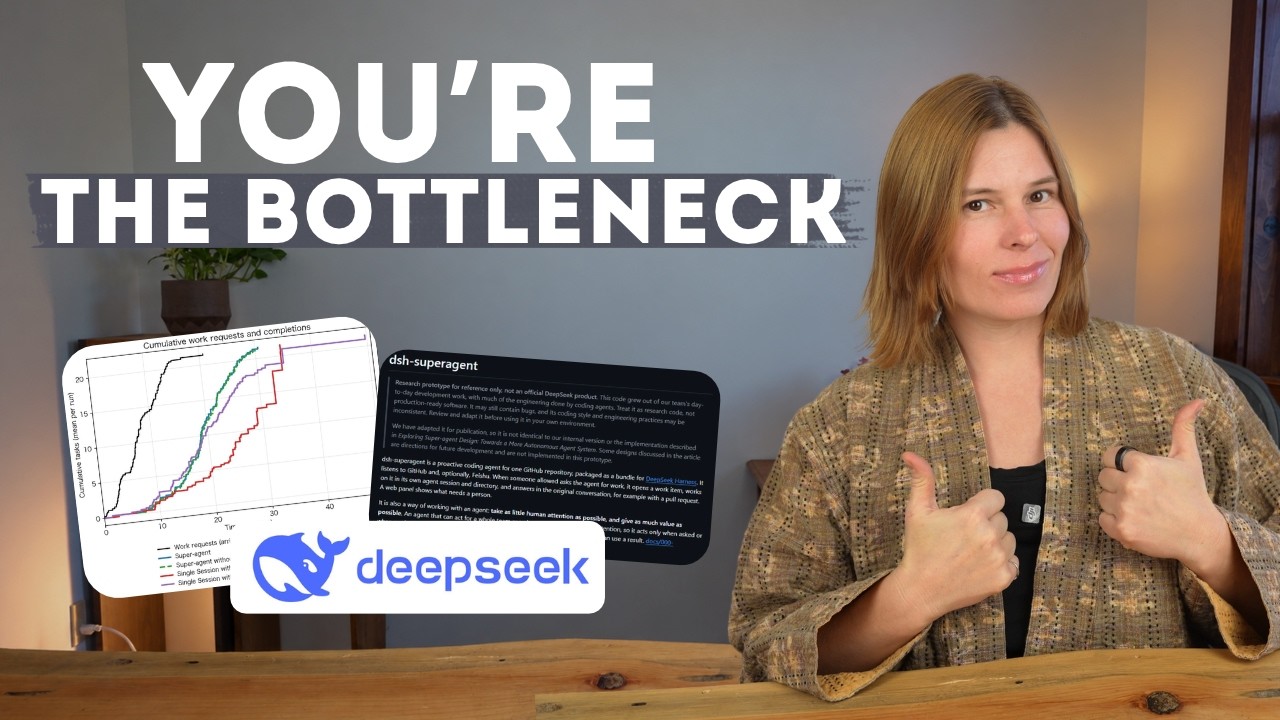 | DeepSeek’s Super-Agent Wants to End AI Babysitting |
|
|
| |
| | |
| | | | | We are reading / watching | Agentic AI is myth set in motion – Henry Farrell goes back to Homer’s storytellers to ask what happens when a machine can act out the stories it has learned from us. The October inflection point for vibe game development – Simon Willison lets you judge for yourself whether AI-generated games have gotten fun, right down to a playable pumpkin farm inspired by his hometown’s giant-pumpkin weigh-off. What is work for? – Some people told the DeepMind Institute they’d keep their jobs even with a guaranteed income above their salary, raising a question about what else work gives us. State of AI 2026 – At 59:02, Nathan Benaich and Matt Turck discuss an AI Genius Bar where a small-business owner could walk in with a task and get hands-on help putting AI to work on it. Transcript
|
| |
|
| | | | Twitter Library | | Save this list with 10 best sources to explore harness – we update it regularly. Open the collection → |
| |
|
| | | | News from the usual suspects ™ | Which of this week’s new models can you actually use? Google has a guest list. Mistral put a trillion parameters up for download. Liquid AI’s text model fits in about a gigabyte. Such was the week. | OpenAI | GPT-6.1 Terra brings cheaper visual reasoning and computer use to Work, Codex, and the API. At $1 per million input tokens and $5 per million output tokens, it costs half as much per token as GPT-5.6 Terra. It is pretty good, and I use it most of the time now. GPT-6.1 Terra OpenAI reorganized its Model Spec around five values. The first, faithfulness to human intent, asks models to consider what you meant when your instructions leave room for judgment. The other four are equally aspirational: Minimizing harm, Honesty and transparency, Facilitating human agency and Care. OpenAI also committed to honoring a shared robots.txt signal for publishers’ AI training preferences. Model Spec · Training preferences
| Google DeepMind | Gemini 4 Carbon, built for cybersecurity and long-running agent tasks, is going first to selected defenders. Genie 4 lets trusted testers steer a simulated world with sound and dialogue. The Google update you can try today? Ask Gemini to make a PDF, then edit it in the same chat. Gemini 4 Carbon · Genie 4 · File editing in Gemini
| Mistral | Large 4, a.k.a. Le Chonk, is available to download. Mistral reports better coding after three more weeks of reinforcement learning. API prices fell to $0.70 per million input tokens and $2.10 per million output tokens. Model-as-a-service providers need a separate commercial license. Large 4 release and license
| Microsoft / GitHub | Copilot Fusion can send a task to one model or bring in another to critique its answer. GitHub also added projects that span repositories, parallel cloud sessions, and automations. Enterprise customers can pay for AI credits without buying a separate Copilot subscription. How Fusion works · GitHub Universe Microsoft’s MAI Image 2.7 preview can relight a scene, restore a photo, or change the lettering on a sign. MAI Image 2.7
| Anthropic | Anthropic shared six drug-development case studies. In one, Generate Biomedicines used Claude Code to redesign part of a CAR T-cell therapy. In lab tests, the immune cells made roughly ten times as many of the receptors they use to recognize cancer cells. Drug-development case studies
| AWS | | NVIDIA | Give Nemotron 3.5 Transcribe an hour of audio and tell it how you want the transcript. The open-weight model handles 40 languages, speaker labels, and timestamps. Separately, NVIDIA got 42.5% more decoding throughput from Ling-3.0-flash on DGX Spark in its GSM8K test. Nemotron 3.5 Transcribe · DGX Spark experiment
| Liquid AI | LFM3 puts six open-weight models for text, vision, audio, and decisions on one backbone. Each can be fine-tuned on a single GPU. The 1.7B text model supports 256K context and fits in about 1 GB at four-bit precision. LFM3 models and weights
| DeepSeek | DeepSeek adapted its internal Super-agent for a public research release. Give the prototype a GitHub repo, optional Feishu messages, and rules for what deserves attention. It can spot a matching event, start an agent session, and bring back a pull request. Super-agent prototype
| Cisco | Cisco ran 880 five-agent debates. When the agents skipped checking their conclusions, three quarters of those debates ended with all five backing the wrong answer. Cisco released four open-source tools for tracing the reasoning, aligning goals, coordinating decisions, and checking outcomes. Cisco’s study and tools
| Deepgram | | Unexpected, potentially usual suspects | Mirendil | Mirendil trained Fern 0.1 from scratch for researchers who want to follow a failure through code, training logs, and agent traces in one context. It claims a window of up to 10 million tokens and is taking early-access requests. Introducing Fern
|
| |
|
| | | | Research highlight | 🌟🌟 Can two models learn the same picture of the world? |  | The generated captions are in black, the human captions in gray. Both spot the cake. Only the model says the woman is cutting it. For this demo, the only component fitted on image–caption pairs was the map between the encoders. Randall Balestriero and Yann LeCun, Fig. 10 · CC BY 4.0 |
| New banger from Randall Balestriero and Yann LeCun! | If you train one model exclusively on text and another exclusively on images, do their internal worlds ever look the same? Randall Balestriero and Yann LeCun show that with joint-embedding predictive architectures (JEPAs), the answer is mathematically yes. | Training a text encoder on pairs of alternate captions for the same scene produces a representation geometry identical to the vision encoder’s. All it takes to bridge them is a simple rotation. Crucially, reaching that identical geometric alignment via standard next-token prediction required 42 times more data. →read the paper |
| |
|
| | | | Models | 🌟 marks our must-reads this week | | | 🌟 L3G-World – keeps a 3D map of the places its camera has visited. When the camera returns, the model refines the same landmarks. Memory grows as the camera explores new territory, and the system generates nine frames per second. →read the paper 🌟 WorldBridge (added Nov 2, submitted Oct 29) – links a video model to a robot policy. On unfamiliar RoboTwin tasks, success rose from 25.1% to 55.9% after training on videos of those tasks. One demonstration per task with labeled actions brought it to 70.7%. →read the paper 🌟 PDRVLA – trains a robot to anticipate how an object will look, move, and change depth. Those predictions guide the next action without rendering a video at deployment. Success reached 99.3% on LIBERO and 89.9% on LIBERO-Plus, both in simulation. →read the paper Hy-Nomas – lets you move the camera and change instructions midway through a generated video. The 8B model keeps scene details available across segments while applying each new command only during its intended interval. →read the paper OSWAM – learns from future observations during training, then produces actions in one step. Its compiled model ran in 40 milliseconds on an RTX 5090. The team tested it on driving and robot control. →read the paper Youtu-Parsing-Omni – uses one 5B model to read pages, images, audio, and video. It records where or when it found each piece of information, so a downstream agent can trace an answer to a spot on a page or a moment in a recording. →read the paper
|
| |
|
| | | | Research | Trends we see in this week’s selection: | Scene continuity: What should persist when the camera turns or a cut happens? Several papers test what models actually remember across scenes. Targeted rewinds: Robots and agents learn faster by replaying the exact moment an action failed, rather than the whole run. Environment verification: Before agents practice, tools like WebAnything and WorkFactory check if the task is even solvable with the data provided. Latency trade-offs: When is extra reasoning worth the delay? New work benchmarks when a fast check beats a heavy model.
| What survives a change of scene? | 🌟 HaMo – turns past web-agent runs into short strategy cards the agent can retrieve on its next task. It also updates the model’s weights so the agent learns when a card applies. Combining the two helped agents transfer strategies across websites. →read the paperMore Memory, Better Videos? – shows what happens when a video generator retrieves an old image. It brings back more of the right characters and objects, but can also restore an outdated appearance or return someone who has already left the story. →read the paper Probing Spatial State Representations – tests ten frozen visual representations on indoor scenes. Some encode an object’s position while it’s visible, then lose track of it when the camera turns. The researchers also test whether the remembered position helps choose a move. →read the paper
| What can a robot learn from a second attempt? | 🌟 Rollback – rewinds a simulated attempt to a decision that changed the outcome, then tries several actions from there. Real robot trials correct the simulation. Against the strongest baseline, success rose by 11.1 percentage points on ball tossing and 11.9 on tabletop curling. →read the paper
|  | Four throws start from the same moment in the simulation. Each color traces a different sequence of actions. The frames on the right show where the ball ends up relative to the blue bucket. Jiayi Luo et al., Fig. 10 · CC BY 4.0 |
| ThinkWorld – represents human and robot motion with the same set of tokens. After learning from labeled demonstrations, it can train on ordinary human video by rewarding a predicted movement when its outcome matches what happens on screen. →read the paper 🌟 CausalWAM (added Nov 2, submitted Oct 30) – lets the world model predict the whole scene while limiting which features can steer the robot. The authors test whether this separates the factors that drive an action from background changes, both in synthetic settings and on real robots. →read the paper Can LLMs Uncover Hidden Physical Laws? – gives agents a simulated world where familiar physics can change, then lets them choose their own experiments. Of twelve models, only GPT-6-Astra discovered any of the altered laws. Its discovery rate was 16.7%. →read the paper
| Better practice for agents | 🌟 MiRL – restarts a terminal agent just before a mistake it often makes. The agent earns a reward for passing the tests and avoiding that mistake. On unfamiliar task histories, a 4B model repeated the targeted errors 43–57% less often. →read the paper 🌟 WebAnything – reconstructs websites where agents can practice, then uses a separate verifier to check that tasks work. It produced 244 sites and 12,984 verified tasks. Training on the resulting interactions raised Qwen3.5-9B’s WebArena-Verified success by 13.33 percentage points with the same harness. →read the paper WorkFactory – checks whether a simulated workplace actually contains the information an agent needs to finish a job. Trial runs expose missing or inconsistent inputs. The team built 112,686 tasks across 612 occupations. →read the paper
| When to look again or ask | 🌟 DecoyCount – asks how many water bottles are in a picture. There are six, but the wrapper says 24. Across 1,660 photos with traps like this, every tested model scored below 50% without a cue. A hint about what to count added 11.8–22.1 percentage points. →read the paper AskStream – tests whether a video assistant can tell when to wait for the next frame, answer now, or ask what the viewer meant. Across 438 videos, the best model scored 52.18% on the benchmark’s measure of when to ask. →read the paper
| Where to spend the next millisecond | Look Only When Needed – lets a diffusion vision-language model reuse its last image-conditioned prediction while new predictions agree with it. Across ten benchmarks, LLaDA-V retained 99.6% of its score using 35.3% of the usual decoding computation. →read the paper TAO – schedules model inference and tool calls together. It accounts for when a tool will return and which GPU still holds the session’s cached data. Across twelve workload settings, latency fell by up to 26.8% against the strongest baseline. →read the paper REA (added Nov 2, submitted Oct 30) – keeps a fast robot policy running while a slower model handles decisions that need more reasoning. In 3,000 simulated LIBERO-Pro episodes, the system reached 95.9% success versus 94.7% for its best individual policy, and cut control time by 17%. →read the paper
| That’s all for today. Thank you for reading! Please share this newsletter with colleagues who want to understand how AI is developing. |
| |
|
| | | | | |
|