The Sequence Radar #811: Last Week in AI: OpenAI's Capital Leap, India's Summit, and the Next Frontier of Models
Was this email forwarded to you? Sign up here The Sequence Radar #811: Last Week in AI: OpenAI's Capital Leap, India's Summit, and the Next Frontier of ModelsNew Models, massive funding rounds and India's AI ambitions
Next Week in The Sequence:
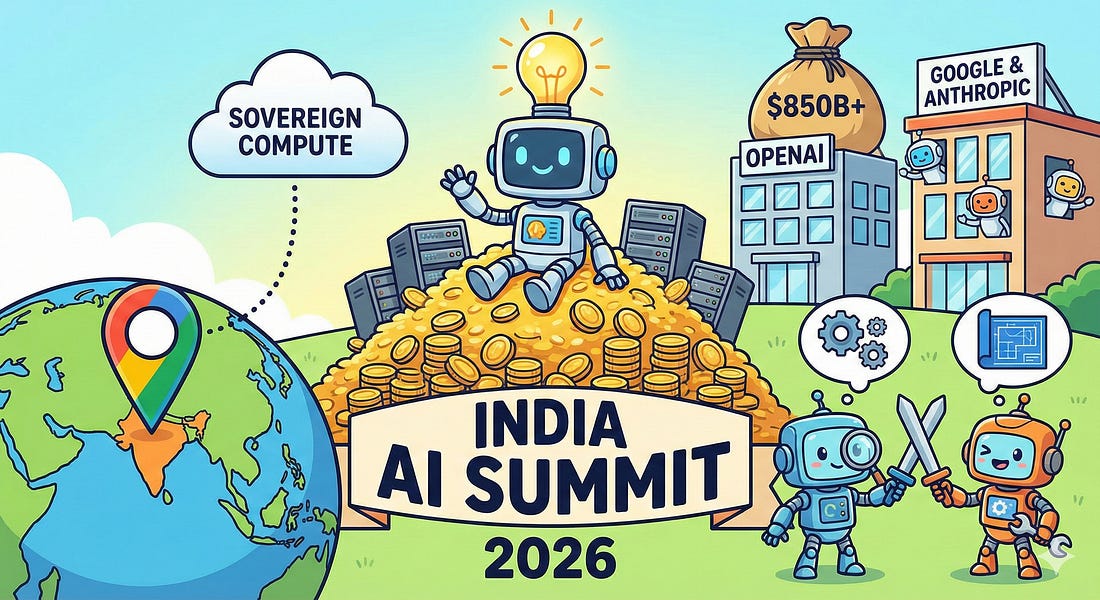
Subscribe and don’t miss out:📝 Editorial: OpenAI’s Capital Leap, India’s Summit, and the Next Frontier of ModelsThis week in artificial intelligence felt like an inflection point where the sheer scale of capital, algorithmic breakthroughs, and geopolitical maneuvering collided. From New Delhi to Silicon Valley, the events of the past few days underscore a fundamental transition: AI is no longer just a software layer; it is quickly becoming the most capital-intensive infrastructure project in human history. The most staggering news of the week is OpenAI’s impending capitalization. The ChatGPT developer is reportedly finalizing the first phase of a historic $100 billion funding round. This unprecedented injection of capital is expected to push OpenAI’s post-money valuation beyond $850 billion, up from a pre-money valuation of $730 billion. What is particularly notable is the consortium of strategic corporate investors. Reports indicate that Amazon is discussing a $50 billion investment, alongside $30 billion from SoftBank and $20 billion from Nvidia, with Microsoft also participating. This massive capital formation is explicitly aimed at giving OpenAI the resources to prepare for multi-trillion-dollar infrastructure projects, highlighting that the primary bottleneck for advanced AI is now silicon, power, and data centers. As OpenAI gathers capital, the model-layer competition remains fiercely relentless. Anthropic released Claude Sonnet 4.6, a model that radically advances agentic computer use and software engineering. Featuring a massive 1-million-token context window in beta, Sonnet 4.6 exhibits human-level capabilities in multi-step tasks, such as navigating complex spreadsheets, and often outperforms Anthropic’s own Opus 4.5. Google swiftly countered with the release of Gemini 3.1 Pro. Positioned as an incremental but highly vital enterprise upgrade, Gemini 3.1 Pro delivers a verified 77.1% on the ARC-AGI-2 benchmark—more than doubling the reasoning performance of its predecessor. The model also introduces the novel ability to natively generate website-ready, animated Scalable Vector Graphics (SVGs) using pure code directly from text prompts. Furthermore, Google recently deployed a major upgrade to its Gemini 3 Deep Think mode, targeting complex research, mathematics, and physics challenges. The deployment of these models requires a global footprint, a reality on full display at the India AI Impact Summit 2026 in New Delhi. Hosted at Bharat Mandapam, the summit cemented India’s role as a critical hub for global AI infrastructure, securing over $250 billion in infrastructure-linked investment commitments for data centers, power systems, and digital connectivity. Tech giants aggressively courted the Global South at the event. Microsoft committed to investing $50 billion by the end of the decade to expand AI access across developing nations. Meanwhile, Google announced the “America-India Connect” initiative, which promises new strategic fiber-optic routes linking the U.S., India, and the Southern Hemisphere, complemented by DeepMind partnerships tailored for Indian national priorities. The summit even secured a Guinness World Record for gathering over 250,000 pledges for “Responsible AI” within 24 hours. This week makes one thing abundantly clear: the AI ecosystem has matured into a sovereign-level discipline. As models like Sonnet 4.6 and Gemini 3.1 Pro unlock autonomous agentic capabilities, the underlying hardware and infrastructure are receiving hundred-billion-dollar commitments. For researchers, developers, and enterprise leaders, the gap between prototype and planetary-scale deployment is closing faster than ever. 🔎 AI ResearchTowards a Science of AI Agent ReliabilityAI Lab: Princeton University Summary: This paper proposes a holistic performance profile for AI agents by introducing twelve concrete metrics that decompose reliability into consistency, robustness, predictability, and safety. By evaluating 14 agentic models across two benchmarks, the authors demonstrate that recent capability gains have only yielded small improvements in agent reliability. GLM-5: from Vibe Coding to Agentic EngineeringAI Lab: Zhipu AI & Tsinghua University Summary: This paper presents GLM-5, a next-generation foundation model that adopts DeepSeek Sparse Attention (DSA) to significantly reduce training and inference costs while maintaining long-context fidelity. It utilizes a new asynchronous reinforcement learning infrastructure to decouple generation from training, achieving state-of-the-art performance on complex, end-to-end software engineering challenges. HLE-Verified: A Systematic Verification and Structured Revision of Humanity’s Last ExamAI Lab: Alibaba GroupSummary: To address concerns about noisy and ambiguous items in the Humanity’s Last Exam (HLE) benchmark, this paper introduces a verified and revised version called HLE-Verified. Through a rigorous two-stage validation and repair workflow, the authors correct systematic errors in problem statements and reference answers, enabling more faithful measurements of language model capabilities. How Much Reasoning Do Retrieval-Augmented Models Add beyond LLMs? A Benchmarking Framework for Multi-Hop Inference over Hybrid Knowledge ,AI Lab: IBM Research, Massachusetts Institute of Technology, Cornell University, & University of Central Florida Summary: The authors introduce HYBRIDRAG-BENCH, an automated framework for constructing benchmarks to evaluate retrieval-intensive, multi-hop reasoning over hybrid unstructured text and structured knowledge graphs. By utilizing recent scientific literature to minimize pretraining contamination, the framework generates challenging question-answer pairs that genuinely test a model’s retrieval and reasoning abilities. Experiential Reinforcement LearningAI Lab: University of Southern California, Microsoft, & University of Pennsylvania Summary: This paper introduces Experiential Reinforcement Learning (ERL), a training paradigm that embeds an explicit experience-reflection-consolidation loop into the reinforcement learning process. By having the model generate self-reflections to guide refined attempts and internalizing successful corrections, ERL significantly improves learning efficiency and final performance in sparse-reward control environments and agentic reasoning tasks. Multi-agent cooperation through in-context co-player inferenceAI Lab: Google Summary: This research demonstrates that training sequence model agents against a diverse distribution of co-players naturally induces in-context best-response strategies without requiring hardcoded assumptions about learning rules. The resulting in-context adaptation makes agents vulnerable to extortion, creating a mutual pressure that resolves into the emergence of robust cooperative behaviors in decentralized multi-agent reinforcement learning. 🤖 AI Tech ReleasesGemini 3.1 ProGoogle DeepMind released Gemini 3.1 Pro, the newest version of its marquee model which is setting records across different benchmarks. Sonnet 4.6Anthropic released Claude Sonnet 4.6 which excels in computer use and long-context reasoning tasks. Tiny AyaCohere open sourced Tiny Aya, a new series of small models for multilingual operations. 📡AI Radar
You’re on the free list for TheSequence Scope and TheSequence Chat. For the full experience, become a paying subscriber to TheSequence Edge. Trusted by thousands of subscribers from the leading AI labs and universities.
|






Similar newsletters
There are other similar shared emails that you might be interested in: