How Adobe’s Tech Lead Works and Uses AI
- Gregor Ojstersek from Engineering Leadership <gregorojstersek@substack.com>
- Hidden Recipient <hidden@emailshot.io>

Hey, Gregor here 👋 This is a free edition of the Engineering Leadership newsletter. Every week, I share 2 articles → One paid edition and one free edition, with a goal to make you a great engineering leader! Here are some of the recent popular paid articles you might have missed: How Adobe’s Tech Lead Works and Uses AICase study from my book The Multiplier Mindset, published by O’Reilly.
This newsletter is sponsored by Unblocked. A Pile of MCP Connectors Is Not a Context Engine Your team connected Slack, Jira and GitHub over MCP, and engineers still spend their time steering agents to the right answer.
This article looks at why: connectors fetch from one tool at a time, so every agent stitches the pieces together itself, trusts the first doc that looks right, and adds a search to your token bill each time. Read what changes when a context engine sits on top of your connectors: the same coding task finished 83% faster at 48% lower cost. Thanks to Unblocked for sponsoring this newsletter. Let’s get back to today’s thought! IntroMy book The Multiplier Mindset published by O’Reilly has recently been released, and has also been a #1 Bestseller (or close to) on Amazon for the past 2 weeks.
In the part 2 of the book, I feature 8 case studies of successful multipliers (tech leads, engineering managers, staff engineers, and architects), looking at:
Today, I am sharing the case study of Navya Agarwal, Tech Lead at Adobe, which is included in the book. Let’s start! What Navya Agarwal Does
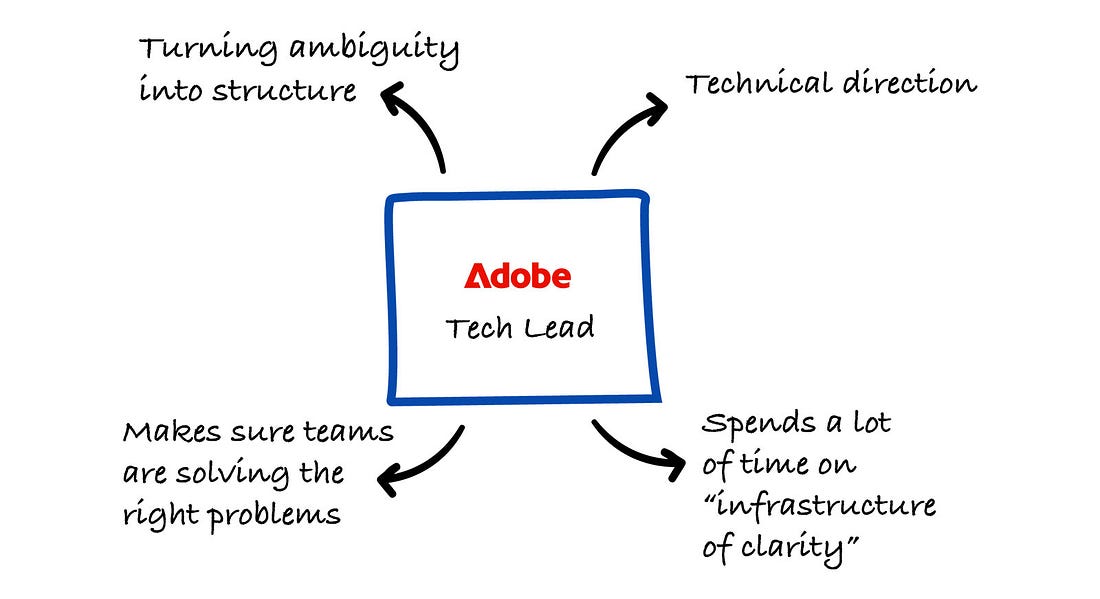
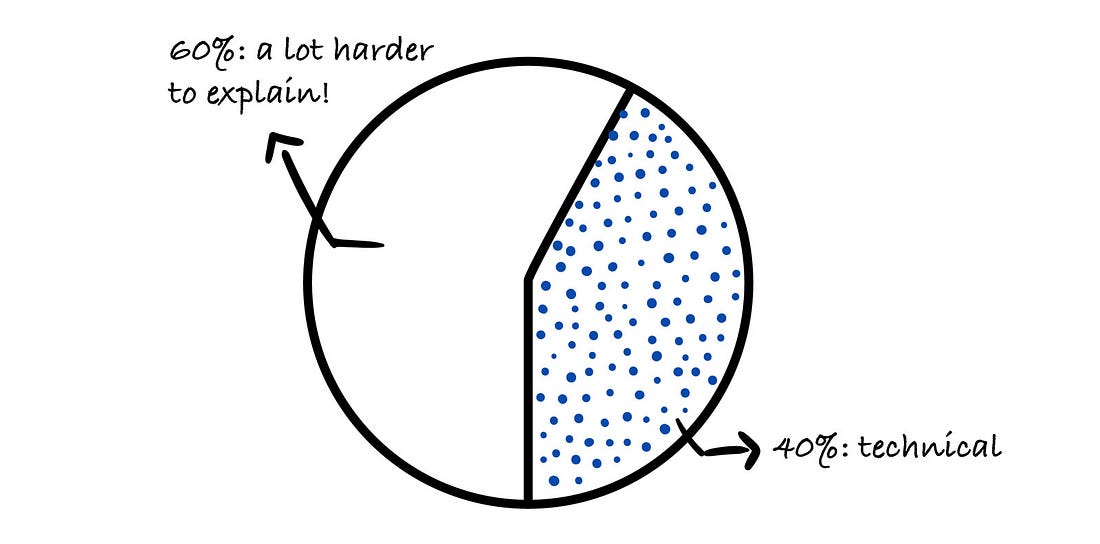
A few years ago, if you’d asked Navya Agarwal what a tech lead does, she would have answered in technical terms: the tech lead is the person who knows the system best, makes design decisions, reviews code, and keeps projects moving. Today, as a tech lead herself, she says this:
At Adobe, her work spans technical direction, cross-functional coordination, and team support. She works with product managers, designers, engineers, and other teams. She helps shape scope, surface trade-offs, and make sure teams are solving the right problems, not just the most visible ones. She also spends a lot of time on what she calls the infrastructure of clarity: documentation, decision logs, onboarding guides, and thoughtful code reviews. These might not be glamorous, but they’re where much of the real leverage lives. A well-written architecture decision record (ADR) can save a team from having to reconstruct context months later, when the original conversation is long forgotten. The biggest shift in Agarwal’s thinking has been moving away from the idea that her value is measured by how much code she personally writes. Early in her career, impact felt like output. More features, more commits, more visible progress. As she grew into leadership, she realized that real leverage comes from helping other people do excellent work. If she makes the team better, faster, and clearer, the resulting impact outweighs anything she could build alone. 1. How Agarwal Succeeds In Her RoleWhat makes Agarwal most effective in her role, she says, isn’t technical skill. It’s being willing to slow down and say, at precisely the moments when social pressure says the team should just get started, “Wait, do we actually agree on what we are trying to do here?” Building a culture where raising concerns is valuedEarly in her leadership journey, Agarwal explains, she had a habit of absorbing ambiguity herself. She’d read between the lines of a brief, make a judgment call, and hope it was right. It often was. But the cost of correcting problems late in the development process was always much higher than it would have been if the problem had surfaced earlier. Now, she tries to externalize uncertainty quickly. If she doesn’t know something, she says so. If a goal feels not as clear, she calls it out, saying “I want to make sure we are all picturing the same outcome. Can we spend five minutes on that?” Most of the time, it turns out they were not picturing the same thing at all. Agarwal also cares deeply about building a culture in which raising concerns early is genuinely valued, not just tolerated. There is a difference. Tolerated means people can speak up but sense a slight friction when they do. Valued means the team treats early warnings as useful data, not as someone being difficult. She shared a story that illustrates this point:
This story, Agarwal says, is the one she comes back to most often:
Building a psychologically safe environmentThere is a large body of research on psychological safety, the idea that teams perform best when people believe they will not be punished or humiliated for speaking up. Google’s Project Aristotle, which studied over 180 teams, found that this was the single most important factor in team effectiveness, more than talent, structure, or resources. Agarwal has seen this play out enough times that she no longer thinks of psychological safety as a soft idea. She sees it as a performance input. Building a psychologically safe environment requires consistency from the tech lead, who must respond to candor with curiosity, not defensiveness, enough times and clearly enough that it becomes the team’s default assumption about how they operate. Agarwal shares an example of modeling this:
That kind of small moment shapes culture more durably than any process or framework. When a leader actively names and appreciates someone for raising a hard thing, it sends a signal that the whole team absorbs: speaking up is what you actually want. 2. How She Multiplies OthersThe word multiplier clicked for Agarwal when she understood its opposite: a tech lead who is the answerer of every question, the approver of every decision, and the person the team waits on before moving. She has seen that pattern and admits that she’s probably been that person at some moments. “A multiplier,” she explains, “is not the person everyone depends on. A multiplier is the reason the team does not need to depend on any one person at all.” The damage that comes from feeling psychologically unsafe is quiet but real: people stop developing judgment because they don’t need it. They stop feeling ownership because they don’t really have it. Truly multiplying your team means increasing their capability without increasing their dependence on a tech lead. According to Agarwal, the levers she uses most are clarity, documentation, and deliberate restraint. Creating clarity“Clarity first,” Agarwal declares. When people understand the objective, the constraints, and what “good” looks like, they can make better local decisions without escalating. That creates velocity, but more importantly, it creates ownership. People grow when they are trusted to think, not just told what to do. Documenting everything that’s importantAgarwal considers documentation one of the most consistent (and widely underrated) multipliers in engineering. She thinks of it as “paying forward context.” Creating documentation isn’t just a bureaucratic obligation but part of the engineering system itself. If something is important enough to keep explaining in Slack, it’s important enough to write down. Each person who finds what they need in her documentation is someone who isn’t blocked while waiting for her to answer a question. Exercising deliberate restraintOne of the most rewarding things Agarwal ever did as a tech lead, she says, was watch one of her reports step up to a level of ownership that they didn’t think they were ready for. This engineer was “technically strong but consistently deferred in design discussions.” She waited to see what others thought before speaking. When I asked her about this pattern, she said this:
“Deliberate restraint is the hardest lever,” she adds:
3. How She Builds a Thriving TeamThere’s a big difference between a performing team and a thriving team. A performing team hits goals. A thriving team hits goals, develops its people, surfaces problems early, and doesn’t crater when something goes wrong. The foundation of a thriving team is genuine trust. Being on the lookout for the politeness trapAgarwal says she’s learned to watch for what she calls the politeness trap: a situation in which a team is technically aligned but nobody voices their reservations. Everything sounds smooth in meetings. The real concerns live in one-on-ones or in direct messages between engineers after the call ends. When that happens, it usually means they feel unsafe disagreeing in public. She counteracts it by modeling uncertainty herself:
Being transparentAnother way Agarwal builds trust is by being transparent about what’s possible. She describes a project where the timeline and scope were not compatible, not dramatically, nobody was panicking, but the math just did not add up. The project was going to be late, or the team was going to ship something rushed, or she was going to put the team through a bruising sprint for a medium-priority feature. So here’s how she responded:
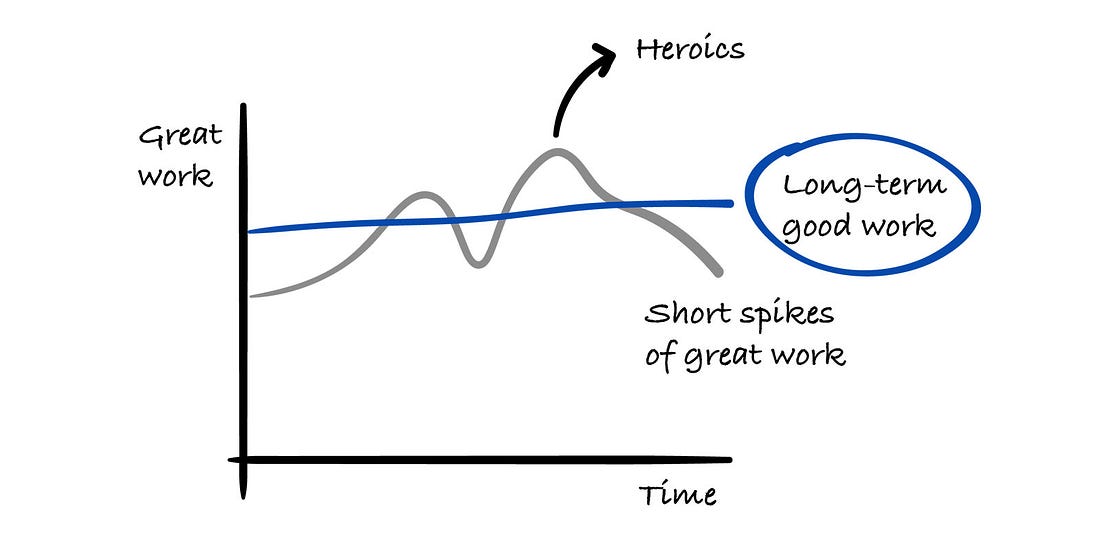
Avoiding heroics
She also cites a piece of internal Adobe engineering guidance:
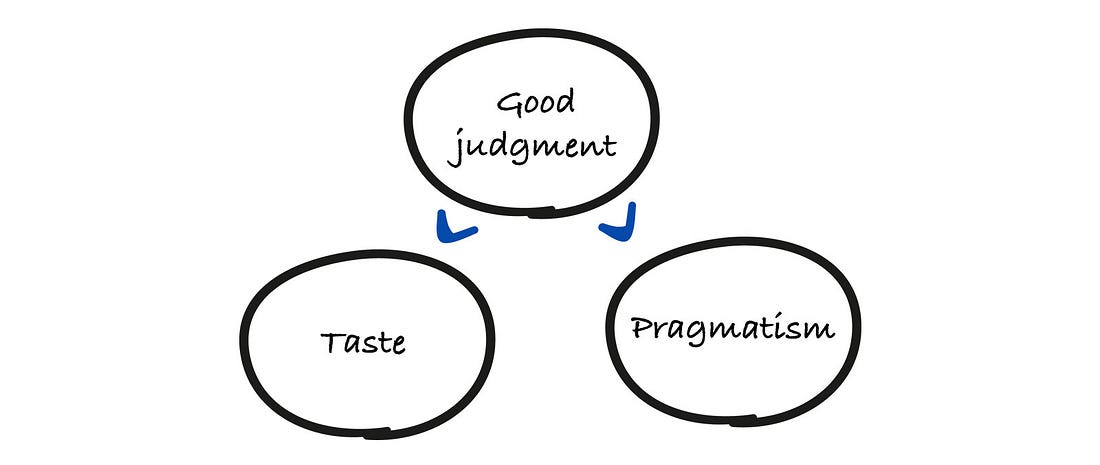
4. How She Leverages AIAgarwal says that while AI hasn’t fundamentally changed the role of tech leads, it has placed more of a premium on clarity, alignment, and judgment. When the incremental cost of producing code approaches zero, the question shifts from “Can we build this?” to “Are we building the right thing, the right way, for the right reasons?” That’s a leadership question. That’s a clarity question. That’s a documentation question. These questions were always important; now, they’re critical. Exercising good judgment and being deliberateAgarwal quotes Kent Beck, one of the pioneers of extreme programming, describing the moment when he encountered generative AI for the first time. In a blog post titled “90% of My Skills Are Now Worth $0”, Beck wrote that while 90% of what he’d spent his career learning had suddenly become less relevant, “The leverage for the remaining 10% went up 1000x. I need to recalibrate.” That 10%, he explained, is about judgment: understanding the system, reading the trade-offs, knowing when something works technically but not organizationally, and sensing when a plan is sound on paper but wrong in practice. AI is most dangerous, Agarwal says, when it creates the illusion of progress. A model will produce code confidently, and the code will often run. But code is written for humans to read as much as for machines to execute. AI-generated code that nobody on the team truly understands is not an asset; it’s debt with a faster accumulation schedule. The antidote, she says, is being deliberate:
Writing the first draft, not the final draftAgarwal advises her team to use AI as a way to lower the cost of the right behaviors rather than a way of skipping them.
“That is the multiplier effect I am after: more time on thinking, less time on typing,” she says. “AI raises my floor,” Agarwal says. “It makes the average quality of my work more consistent. But the ceiling, the work that is trusted, differentiated, and irreplaceable, still requires a person who has context, relationships, and taste.” She says AI has changed her work the most in terms of drafting written documents:
She notes that tech lead work requires a great deal of context switching: “In a single hour, I might move from a technical review to a planning discussion to a teammate’s question to a cross-functional conversation.” AI, she says, helps her clarify her thinking quickly and move on. But she protects “the relational and judgment-heavy work.” She explains it this way:
5. Her Advice For EngineersHere are Agarwal’s tips for thriving in the AI era.
Let it draft, summarize, and explore. Use it to learn faster, write better, and help you move into unfamiliar domains with more confidence. But keep your stand
ards high, your communication honest, and your thinking genuinely your own. The engineers who will thrive in the AI era are the ones who combine technical fluency with taste, who know when generated output is wrong even when it looks right.
The dopamine hit of going from prompt to running app is real and addictive. But anything you are going to maintain, evolve, and stand behind requires the boring discipline: design before code, tests alongside code, and review that actually engages with what has been built. The fundamentals do not disappear because generation has gotten easier. They become more important because the cost of skipping them has gotten harder to see.
Documentation. Realistic planning. Honest onboarding. A culture where people surface problems early rather than absorbing them silently. These are not soft investments. They are the foundation that determines whether technical work can actually succeed.
If your team’s heroes are always the ones staying up late, ask what the system is doing that keeps requiring rescue. Heroism that becomes routine is a planning problem in disguise.
Speed without clarity is just faster confusion. Use AI where it genuinely reduces friction on the right behaviors. Do not let it become a way to skip the conversations that create alignment.
If you care about the craft, about building systems that are well-designed, well understood, and built to last, then this is the best time to be doing it. The parts of the job that are being automated are the parts that were always the least interesting. The parts that remain are the parts that were always the most important. Final thoughtsAgarwal says that while she used to measure her success by what she built, she now measures it by what the team becomes:
Agarwal thinks of the engineers she works with not as resources to direct but as people who make the actual work happen. “My job,” she says, “is to make that work possible: clearer, safer, and more impactful than it would be without me in the room.” Last wordsSpecial thanks the Navya for sharing all these insights with us! If you haven’t yet, make sure to check out the book The Multiplier Mindset, where you can find more case studies similar to this one. Liked this article? Make sure to 💙 click the like button. Feedback or addition? Make sure to 💬 comment. Know someone that would find this helpful? Make sure to 🔁 share this post. Whenever you are ready, here is how I can help you further
Get in touchYou can find me on LinkedIn, X, YouTube, Bluesky, Instagram or Threads. If you wish to make a request on particular topic you would like to read, you can send me an email to info@gregorojstersek.com. This newsletter is funded by paid subscriptions from readers like yourself. If you aren’t already, consider becoming a paid subscriber to receive the full experience! You are more than welcome to find whatever interests you here and try it out in your particular case. Let me know how it went! Topics are normally about all things engineering related, leadership, management, developing scalable products, building teams etc. You're currently a free subscriber to Engineering Leadership. For the full experience, upgrade your subscription.
|







Similar newsletters
There are other similar shared emails that you might be interested in: