Travel Tech Essentialist #197: Human Leverage
- Mauricio | Travel Tech Essentialist <traveltechessentialist@substack.com>
- Hidden Recipient <hidden@emailshot.io>
AI makes strengths stronger and weaknesses worse. This edition is about learning to control the direction. 1. The Travel Tech Essentialist Copilot just got a lot smarterSix weeks ago, I introduced an AI agent for travel founders, operators, and execs. But in the past two weeks, I rebuilt it from the ground up, and it's a much-improved tool. The new Travel Tech Essentialist Copilot is an AI thinking partner for travel founders and operators that combines the best thinking on growth and product with deep travel industry knowledge. It draws on three sources: six years of Travel Tech Essentialist newsletters covering the full arc of travel tech; every episode of Lenny's Podcast with conversations with 300+ of the world's best product and growth minds; and my hard-won lessons from building eDreams into Europe's largest OTA, plus years of advising, investing in, and mentoring travel companies since. You can use it to diagnose a conversion problem, pressure-test your landing page, think through a marketplace strategy, or just ask a hard question about your business.
It’s free. Try it and let me know what you think. 2. Two rounds worth pausing onI don’t usually dedicate space to funding announcements because money raised and value created are two different things, and I care more about the latter. I’ll highlight these two because I wrote a Deep Dive on each last year, so I’ve seen the work firsthand. Both have spent years building something real, and the capital finally caught up. Stay22 raised $122M from Summit Partners. Five years ago they had 7 people and negative revenue. Today, they process over $1B in annual transactions and serve 5,500+ creators and publishers. They 20x’d revenue in five years while staying profitable. The round validates the core infrastructure they’ve been building quietly for the creator economy. → Deep Dive from April 17 2025 Wheel the World closed a $3.5M extension, bringing their Series A to $11M. They are solving both a moral and a structural problem. Accessibility information in travel is unreliable by default. Six years of verified data across 150+ destinations and 8,000+ services is how they’re fixing that. → Deep Dive from May 30 2025. I only write Deep Dives when I’d put my own reputation behind the recommendation. Here is my Deep Dive philosophy, and what it takes for me to write about what you’re building. 3. The doorman fallacyImagine replacing a hotel doorman with an automatic door sensor. A consultant celebrates the cost savings, but no one accounts for what disappears: security, recognition for regulars, and a warm welcome. Someone gets credit for the savings and no one gets blamed for the experience getting worse. Rory Sutherland, vice-chairman of Ogilvy, says the same pattern is playing out with AI. The easiest way to sell it to clients is as a cost reduction tool, so that’s how it gets deployed. He describes how companies push customers into their lowest-cost channels, with phone numbers disappearing and self-service becoming the default.
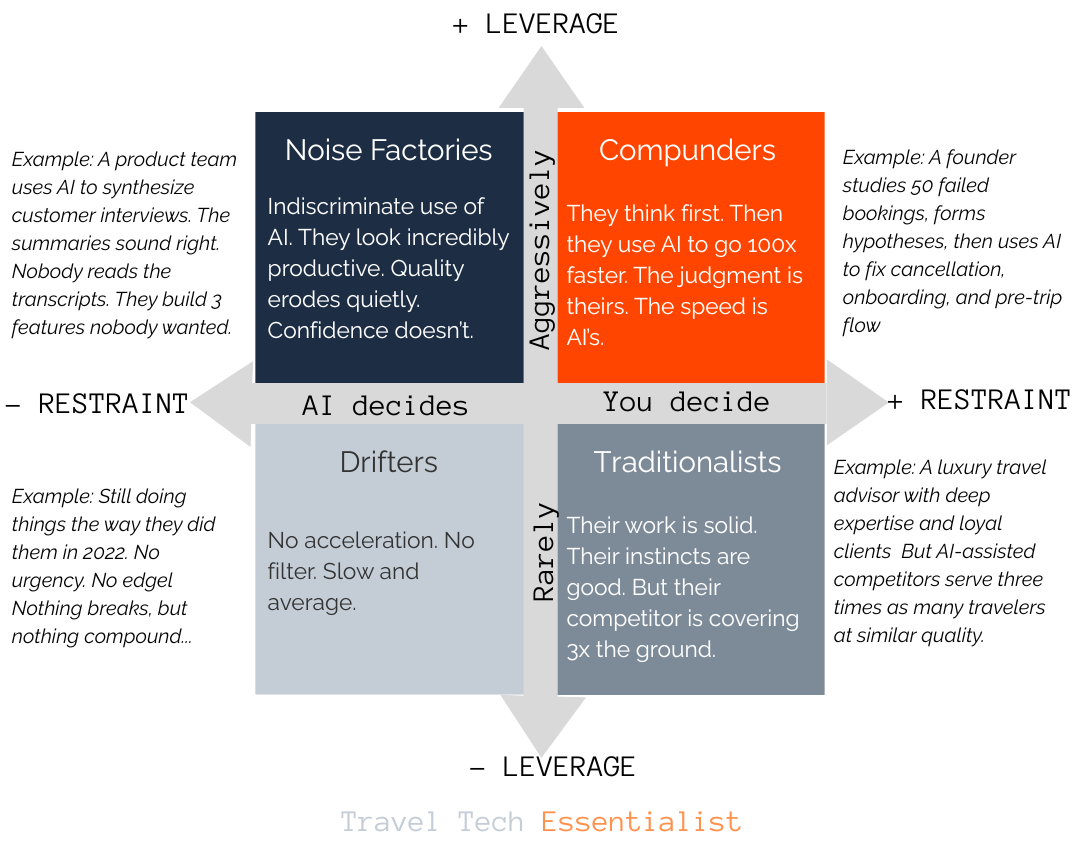
He thinks most businesses will use AI for “the same but cheaper.” A few will use it to add back human elements that never scaled before. Read + Sutherland 4. The “11-star” exerciseRory Sutherland’s closing thought is the challenge: how do we use AI to add back human elements that never scaled before? For one answer, look to Brian Chesky’s “11-star” design exercise. In Airbnb’s early days, Chesky mapped the guest experience from 5 stars to 11. At 5 stars, you knock, the host opens the door, you’re in, and it works. At 6 stars, there’s wine on the table and toiletries in the bathroom. At 7, your host knows you surf, and there’s a board waiting, lessons booked, and a restaurant reservation made. At 10, it’s The Beatles landing in 1964. At 11, Elon Musk meets you at the airport to take you to space. The point is not to reach 11. It is to find the sweet spot between “the door opened” and “I’m going to space.” Historically, that sweet spot was a doorman problem. It didn’t scale because it required a human who knew you; that was expensive, manual, and one guest at a time. Personalization at scale was unrealistic. AI changes that constraint. It can infer preferences, anticipate needs, and act on them before the guest asks, enabling companies to move higher up the scale. Companies will choose between automating away from people or toward them. 5. Thinking fast, slow, and artificialAI can make travelers and operators smarter. It can also make them confidently wrong. Daniel Kahneman, the Nobel-winning psychologist behind Thinking, Fast and Slow, gave us System 1 (fast, intuitive) and System 2 (slow, deliberate). A new Wharton paper proposes a third: System 3, the AI systems we increasingly outsource our thinking to. The researchers tested what happens when people rely on AI to answer reasoning questions. When the AI was right, accuracy jumped 25 points. When it was wrong, accuracy fell 15 points below the no-AI baseline. People followed faulty AI recommendations four out of five times. Confidence went up either way. They call this “cognitive surrender”; not just using AI as a tool, but abandoning critical evaluation entirely. 6. AI makes you better. It also makes you worse.The Wharton finding got me thinking (it happens, sometimes). Cognitive surrender explains what happens, but it doesn’t explain why some people fall into it and others don’t. Two variables explain it.
Think of leverage as the engine and restraint as the steering. Most people are upgrading the engine, but fewer are paying attention to the steering.
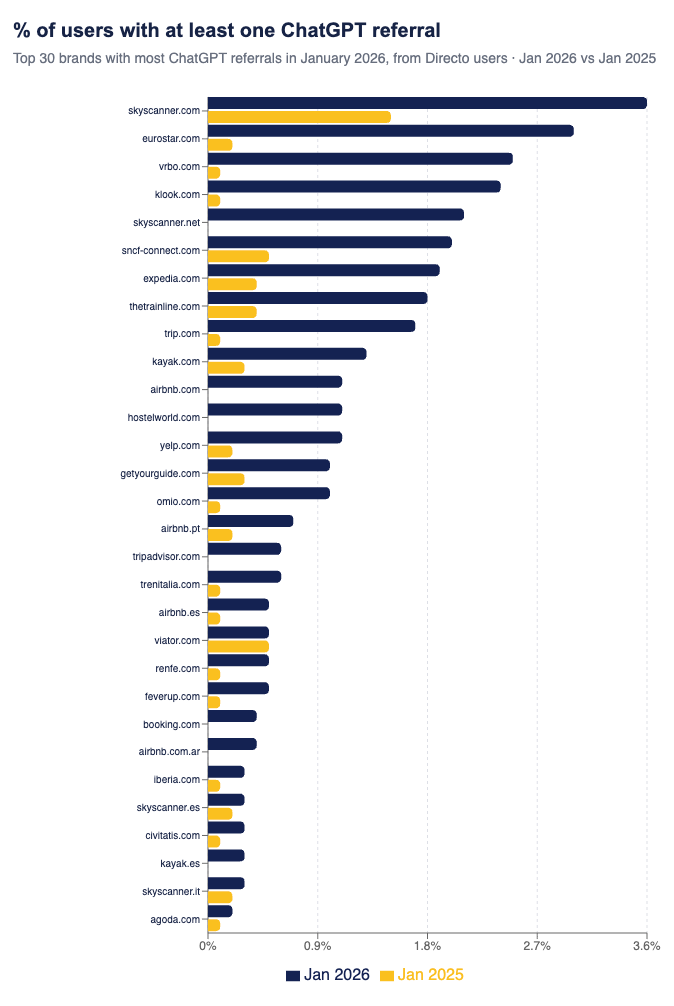
The dangerous quadrant isn’t the bottom row. It’s top-left. Noise Factories aren’t junior people producing mediocre work. They’re experienced operators who know what good looks like but stopped checking whether AI got there. Pre-AI, carelessness was capped by effort. You could only move so fast, but now it scales. The habit that separates Compounders is that they formulate the question clearly, with assumptions made explicit, before opening the prompt. AI accelerates a thought that already exists. It doesn’t replace one that doesn’t. That's the difference between System 3 working for you and working against you. 7. Booking’s February sell-offDespite beating Q4 earnings and revenue expectations on February 18, Booking’s stock has dropped 17% this month, hitting a 52-week low of $3,870. The market’s reaction has less to do with the results and more to do with AI anxiety. I heard a useful framework from Chamath Palihapitiya that can help explain this. In “when” mode, investors are confident the cash flows are real and durable; they’re just debating how long before they become less certain. That gets priced in gradually. But now the question has shifted to “if.” Investors are no longer confident that the cash flows are durable at all. Could agentic AI bypass OTAs entirely? That’s a binary outcome, and markets price those harshly. Multiples get cut because the uncertainty becomes existential, even if the business is breaking records today. That’s the context for Booking.com’s $700 million AI reinvestment announcement. The company remains a massive cash-flow engine, but the market is pricing in a disruption that hasn’t yet shown up in the booking data. The real question is whether $700 million is a defensive move to plug a leak or an offensive bet to own the next era? 8. Fogel’s “Third Spouse” vs. The Agentic ThreatLooking back at Glenn Fogel, CEO of Booking.com, in his interview with Ben Thompson last September, this $700 million reinvestment starts to look less like a panic move and more like the “phase transition” he’s been signaling for years. Fogel’s core thesis is the “Connected Trip”, the idea that technology should finally recreate the role of the 1980s travel agent. He often describes this as a digital “third spouse” that doesn’t just book a room, but proactively fixes your dinner reservations or car service when your flight is delayed. The market is currently obsessed with the idea that AI will allow users to bypass OTAs, but Fogel’s bet is that while a generic LLM can plan a trip, it lacks the backend API integrations across flights, hotels, and attractions to actually execute and manage it when things go wrong in the real world. In a recent McKinsey interview, he was blunt about it: “It will be a very long time before LLMs crack the combination of execution complexity and trust that OTAs have spent two decades building.” The tension here is between the search engine of the past and the service agent of the future. Fogel told Thompson that over 60% of their B2C traffic already comes to them directly, bypassing Google entirely. If Booking can use this capital to move from being a “toll collector” for hotel rooms to a proactive travel partner, that direct loyalty becomes much harder to break. The investment that Wall Street is currently punishing is essentially the price Fogel is willing to pay to ensure that when the Agentic AI era fully arrives, Booking is the one providing the infrastructure rather than being displaced by it. 9. Tryp.com’s feed hypothesisSharing a guest post from André Rangel, co-founder of Tryp.com: Tryp.com: Beyond the Search Bar. His core argument is that the future of travel isn’t chat interfaces or better search bars; it’s algorithmic discovery. The new generation of travelers wants machines to handle the searching and discovery for them. Half of Tryp’s sales come from users who never typed a destination. They just swiped. He also makes a sharp case for why LLMs can’t solve real-time pricing, how “feed data” beats 20 years of legacy booking history, and how they’re acquiring customers at under €5 CAC. Worth reading if you’re thinking about the next generation of OTAs. 10. AI vs OTAs: Early signals from real travel sessionsThe core finding from Directo’s new post on how AI assistants and OTAs coexist inside real user journeys is that AI is winning the moment of inspiration and OTAs still win the moment of payment. Some key signals:
This mirrors early metasearch dynamics. Influence without conversion.
Travel Tech Essentialist Job Board→ Explore all 1791 open roles on the Travel Tech Essentialist Job Board now.
📩 For monthly updates on the latest roles, subscribe to the Travel Tech Jobs newsletter Raising a round?If you are a startup looking to raise a round (from pre-seed to Series D), I can help (for free). Travel Investor Network is a private platform where I recommend innovative travel startups to investors and innovators. If you’re interested, please start by completing this form. If you like Travel Tech Essentialist, please consider sharing it with your friends or colleagues. If you’re not yet subscribed, join us here: And, as always, thanks for trusting me with your inbox. Mauricio Prieto
|




Similar newsletters
There are other similar shared emails that you might be interested in: