Travel Tech Essentialist #202: Gaps
- Mauricio | Travel Tech Essentialist <traveltechessentialist@substack.com>
- Hidden Recipient <hidden@emailshot.io>

A few stories in this newsletter are about gaps. What many predicted for Google hasn’t played out that way. Founders tend to lead with conviction, while hired leaders often play it safe. The most valuable travelers are not the ones most products are built for. And Airbnb’s formal loyalty score doesn’t line up with its NPS. Special thanks to Propellic for sponsoring this edition of the newsletter:
1. Optimism gets you into the game, but pessimism keeps you thereLori Timony, Christian Watts, and Bruce Rosard were kind enough to invite me to their Experience This! podcast The conversation started from my recent newsletter issue The Optimist’s Edge. The central argument is that optimism is a timing advantage. Optimists act before something feels obvious but after it’s directionally true. They invest before the data looks good and that’s their edge. But optimism applied in the wrong place kills companies. Patrick Collison of Stripe put it well: be macro optimist and micro pessimist. Optimistic about the long-term direction, pessimistic and ruthless about execution. Founders who burn through their runway are usually optimistic about both. The ones who never build are pessimistic about both. The only combination that works is macro optimism + micro pessimism. In tours and activities this matters more than in other travel segments. Flights are logistics, but experiences are products built on belief and emotion. If you are not a macro optimist and don’t believe humans have an intrinsic need to travel and explore, there’s no reason to build in this space. If you do, the case for macro optimism is obvious. And from a customer perspective, if they are not feeling optimistic, demand disappears faster, but when optimism returns, this category grows faster than anything else. That emotional need is also what makes this category resilient to AI disruption. If AI continues to automate digital execution, the most valuable companies in travel may be those that make us use screens less. Being physically present is the whole point. 2. The end of Google Search (again)'Is this the end of Google search?' has been a recurring headline. They’re snapshots of how analysts and the media feel about the present, but they’re still just ruminations and have a poor track record as guides to the future. Pieces like these are useful for entertainment and context, but they’re not something founders should lean on too heavily when making long‑term bets.
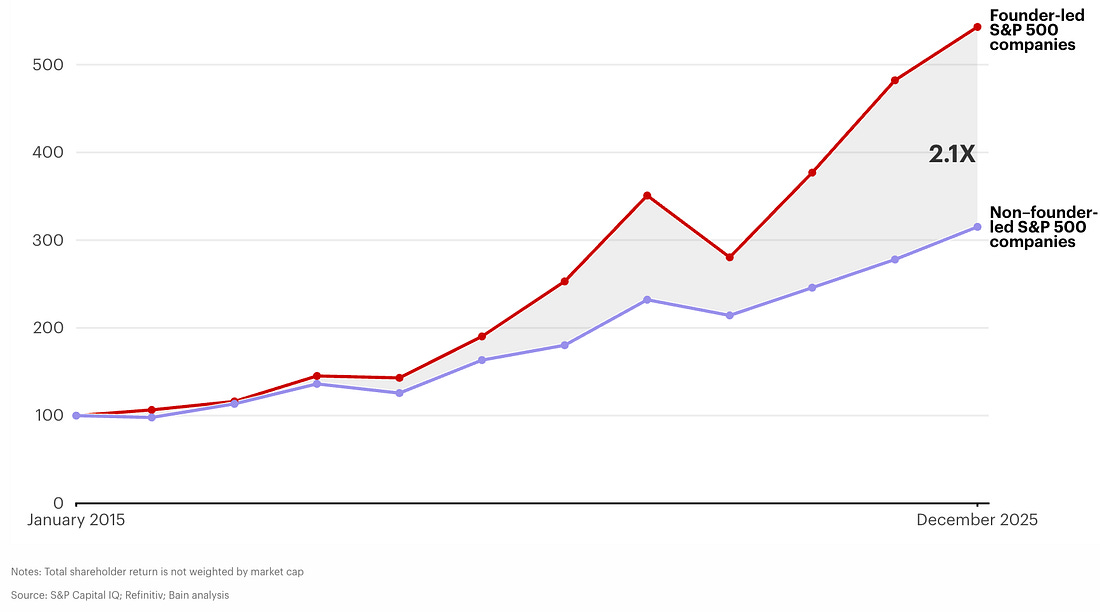
How it’s going for Google (Q1 2026)… → Google Search ad revenue up 19% year‑on‑year to $60.4 billion It turns out that incumbents like Google rarely stay frozen like a deer in the headlights when disruption arrives. 3. The founder’s edgeAcross multiple cycles, the “founder effect” shows up in hard numbers. Bain’s data finds that since 2015, founder‑led companies have delivered 2.1× the total shareholder returns of their non‑founder peers, rising to 2.6× in tech companies. Data from early 2026 indicates that companies where the founder recently departed averaged 6.9% annual returns over five years, compared to 15.4% for those still led by founders. Most CEOs are trained to manage risk but founders act as chief risk officers. They are optimistic about where the world is going and ruthless about execution. The gap widens in eras of disruption. Google is the clearest recent example. After years of being perceived as behind in AI, co-founder Sergey Brin returned to the technical trenches in 2023. The culture shifted, the results followed, and Google’s stock has grown 210% since.
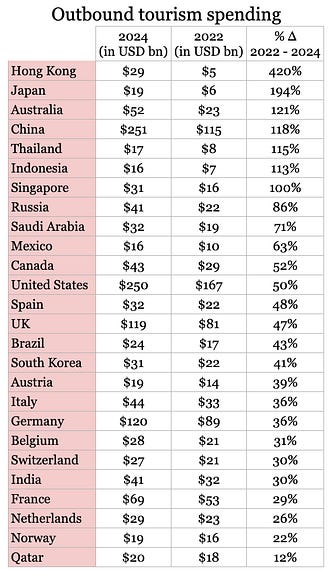
4. "Nobody has figured out AI for travel yet."Brian Chesky’s Q1 earnings call for Airbnb was full of concrete AI thinking. On the internal side, 60% of Airbnb’s code is now written by AI, roughly twice the industry average. Chesky’s takeaway is that the company needs to restructure around speed. In his view, there’s no longer much of a role for hands-off managers running teams from a distance. Design managers and engineering managers are going back to writing code. On the customer side, Airbnb deliberately started AI at the bottom of the funnel, in customer service, because Chesky considered it the hardest problem: no hallucinations allowed, multilingual, high-stakes, real-time decisions. Over 40% of support issues are now resolved without a human agent, up from a third last quarter. Cost per booking fell 10% year-on-year. He made the case for why chatbots, as currently built, don’t work for travel or ecommerce. Four reasons: too much text in a category that is fundamentally photo-forward; no direct manipulation of filters or sliders; comparison at scale becomes impossible inside a thread; and most bookings involve multiple guests while chatbots are built for one person. His conclusion was that nobody has figured out AI for travel yet. 5. Query framing is now a distribution strategyA new study audited 1,357 Gemini citations across 156 hotel queries in Tokyo. Query framing determines whether AI cites an OTA or a hotel’s own website. “Cheap hotel in Shinjuku” returned OTA citations 69% of the time. “Hotel with local charm in Shinjuku” dropped that to 44%. A 25 percentage point swing from rephrasing the same question. Content depth mattered more than brand or technical polish. Hotel K5 has strong ratings and proper schema markup. Gemini mentions it, but cites Expedia, not K5's own site. Kadoya Hotel has no schema markup or SEO, but its 33-question FAQ and 13-attraction neighborhood guide got Kadoya's own website cited directly. The study is Tokyo-specific and Gemini-only, so treat the exact numbers as directional. But the underlying logic is that AI search cites whoever answers the question best. For price queries, that’s still OTAs. For everything else, hotels with deep content can compete. (Thx to Gene Quinn for pointing me to this paper) 6. A headline that works against itselfThe title of this recent eDreams press release: “eDreams ODIGEO further Scales Agentic AI Ecosystem by Integrating Conversational Planning and Immediate Booking Fulfillment.” Buried in the jargon is an in-app trip planner, ChatGPT integration, and voice AI that now handles 90% of call traffic across five languages, with call transfers down 33%, resolution time down 15%, and the whole thing deployed in weeks. Not bad! The title is the opposite of clickbait. It actively discourages people from reading results worth reading. 7. Follow the moneyThis table shows the 25 countries with the highest outbound tourism spending in 2024, ranked by growth since 2022. China and the United States are essentially tied at $250 billion each. No other country is close. Germany and the UK are third and fourth at $120 billion and $119 billion respectively. Seven of the top ten fastest-growing markets in this group are in Asia, and all seven more than doubled.
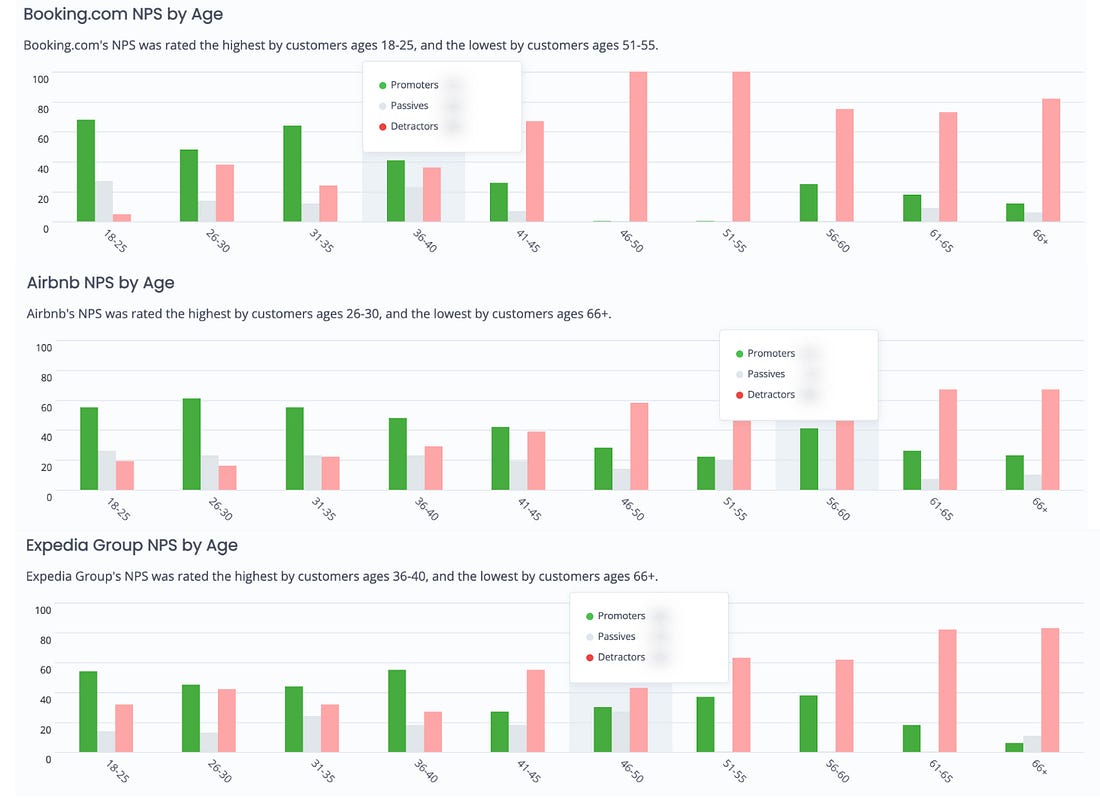
8. The $1.4 trillion demographicEvery travel brand wants to reach Gen Z, but the traveler spending the most is twice their age. Baby Boomers spend an average of $8,242 per trip, more than double what Gen Z spends ($3,753). The 50+ segment accounts for over $236 billion in annual US leisure travel spending. By 2030, the 60+ cohort will reach 1.4 billion people globally and will account for over a third of all international trips. The silver tourism market is on track to hit $1.4 trillion by 2032. This segment still books mostly on desktop, still uses travel agents, plans months out, and has an 8% AI adoption rate for travel planning (94% of those who tried it found it helpful). A demographic with money, time, and demonstrated openness to tools that work for them. There seems to be an opportunity to build products specifically for them. 9. Who the product isn't working forComparably breaks down NPS by age and the pattern is consistent across Booking.com, Expedia and Airbnb; satisfaction drops as travelers get older, with detractors dominating from the mid-40s onwards. Paired with the senior travel spending data above, the charts below show that the most valuable travelers in the market are also the least satisfied with the products available.
10. The loyalty gapCaravelo benchmarked the loyalty programs of the five largest OTAs using a framework built around three pillars: Access (exclusive inventory and belonging), Control (pricing transparency and flexibility), and Convenience (booking ease and digital experience). Across all five programs, Convenience is well covered and Control is getting better. Access (exclusive inventory, belonging, the kind of thing AI cannot replicate) is where every one of them falls short. Airbnb has operated for fifteen years without a formal loyalty program. No tiers, no points, and no member pricing. A traveler who has booked 100 nights receives the same treatment as someone booking their first. On formal metrics, Caravelo scores it near zero on Access. And yet Comparably’s NPS data tells a different story. Airbnb scores 24, Expedia 4, Booking.com -1. Brand-driven loyalty, with no formal program, is outperforming two of the most sophisticated points programs in travel. 🧭 Travel Tech Essentialist Copilot“It reaches a level of business thinking that’s genuinely useful... It goes to the non-obvious and raises the quality of your thinking... Pushes you to make decisions….Direct, no fluff, doesn’t try to please…It’s something I’ll keep using going forward.” — María Montané, Founder & CEO, REVO Studios Try the Travel Tech Essentialist Copilot and let me know what you think. Travel Tech Essentialist Job Board→ Explore all 1988 open roles on the Travel Tech Essentialist Job Board now.
📩 For monthly updates on the latest roles, subscribe to the Travel Tech Jobs newsletter Raising a round?If you are a startup looking to raise a round (from pre-seed to Series D), I can help (for free). Travel Investor Network is a private platform where I recommend innovative travel startups to investors and innovators. If you’re interested, please start by completing this form. If you’ve found value in Travel Tech Essentialist, the best way to say so is to share it with someone who’d appreciate it: If you’re not yet subscribed, join us here: Thanks for trusting me with your inbox. Mauricio Prieto
|





Similar newsletters
There are other similar shared emails that you might be interested in: