Building Social Capital: Guide for Engineers and Engineering Leaders
- Gregor Ojstersek from Engineering Leadership <gregorojstersek@substack.com>
- Hidden Recipient <hidden@emailshot.io>
Hey, Gregor here 👋 This is a paid edition of the Engineering Leadership newsletter. Every week, I share 2 articles → Wednesday’s paid edition and Sunday’s free edition, with a goal to make you a great engineering leader! Here are some of the recent popular paid articles you might have missed: Building Social Capital: Guide for Engineers and Engineering LeadersYou should build social capital daily, not when you need it. This is why!
IntroLast week, together with Shehab Abdel-Salam, we did a deepdive on the importance of building a good relationship with your manager and also how to do it. If you haven’t read it yet, I highly recommend doing so:
Today, we are going a level deeper, we are going through the importance of building good relationships across the organization and also externally with people. To be more precise, we’ll talk about social capital. What that is, why it’s very important, how to build it + what makes it so important if you want to grow in your career. It’s especially a crucial concept to understand for engineering leadership roles or if you wish to grow into a leadership role. This is an article for paid subscribers, and here is the full index: - Financial Capital vs Social Capital Let’s start! Financial Capital vs Social CapitalOften, in our industry, we hear things such as “X company is offering a total compensation of Y for that specific role”, or an engineer is saying that they are making X amount of total compensation (Financial capital). While how much you make is very important, there is also another type of capital that is crucial, and that is social capital. Without it, you won’t be able to get your initiatives accepted, even if you have all the reasons for them to be so. As I like to say:
Managers or stakeholders will only accept ideas where they believe that the risk versus reward ratio is more tilted to the side of the reward. Unfortunately, ideas coming from people with low social capital will be seen as a lot more risky in comparison to people who have high social capital. Let’s define what exactly social capital means next. What Exactly is Social Capital?We can define it in many different ways, but we’ll make it practical for our use case. I like to refer to social capital as a value that comes from relationships.
The more people you know and the higher your trust level + the better overall relationship you have with them, the higher your social capital will be. The higher your social capital in your organization, the easier it will be for you to get ideas and suggestions to be accepted.
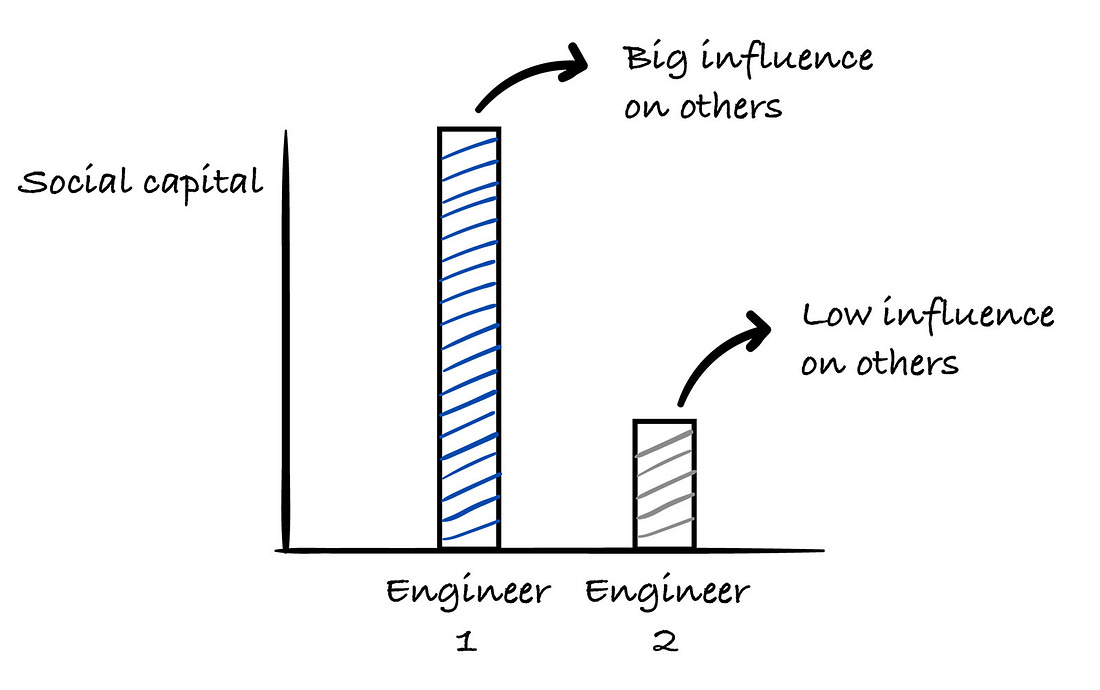
An example of a Software Engineer 1 with high social capital:
An example of a Software Engineer 2 with low social capital:
Yes, You Should Care About It as an Engineer or Engineering LeaderAs I mentioned at the beginning of this article, as an engineering leader, you should care about it a LOT more, because your work highly depends on how good of relationships you have been able to build across the organization. You mostly get things done through others, and with low social capital, you are not able to do that. At the same time, for engineers, it’s also really important, and it’s going to be just more and more as time goes on. I’ve mentioned this before in some of the previous articles that relationships are the #1 important thing at work, and if you are able to build good working relationships, it can really make a big difference in your day-to-day. Many engineers tend to focus a lot more on technical skills, while totally neglecting the aspect of social capital, and that tends to be the #1 mistake of why they don’t get promoted or worse, can mean why they get laid off. Let’s go through a very important concept next, building and using social capital. The Concept of Building and Using Your Social CapitalWhen you help others and when you are talking with others and building relationships, you are increasing your overall social capital. But then at the same time, when you need help or when you need a favor → you are using your social capital. It’s all about balancing giving and taking. If you always take, you tend to completely lose your whole capital, and people won’t be happy to help and support you. At the same time, you won’t be able to influence decisions or get your ideas accepted if you don’t give first and provide value to people. So, this is my recommendation: focus on giving first, and people will be a lot more prone to returning the favor. Now that we understand what social capital is and how important it is for both engineers and engineering leaders, let me share my top tips for building your social capital. How to Build Social Capital?...Subscribe to Engineering Leadership to unlock the rest.Become a paying subscriber of Engineering Leadership to get access to this post and other subscriber-only content. A subscription gets you:
|





Similar newsletters
There are other similar shared emails that you might be interested in: