How to Help Engineers Define Their Growth Goals
- Gregor Ojstersek and Simone D'Amico from Engineering Leadership <gregorojstersek@substack.com>
- Hidden Recipient <hidden@emailshot.io>
Hey, Gregor here 👋 This is a free edition of the Engineering Leadership newsletter. Every week, I share 2 articles → Wednesday’s paid edition and Sunday’s free edition, with a goal to make you a great engineering leader! 1 day left to upgrade your account with 35% off New Year’s deal here: How to Help Engineers Define Their Growth GoalsIt's your job as a leader to help your engineers find their growth goals -> this is how to do that!
Intro
This is really important to understand as a leader, because you are playing a big part in defining the overall culture inside your team and also in your organization. And it all starts with the clarity of defining goals for your people. Do they want to become a Staff Engineer, an Architect, or a Manager? Or are they happy where they are at the moment and wish to grow by learning a new skill? What does growth actually mean for them? Those are all very important questions that, as leaders, we should definitely help our engineers find answers to! How to do that, you may ask? To help us with this, I am happy to bring in Simone D’Amico as a guest author. Let’s introduce our guest author. Introducing Simone D’AmicoSimone D’Amico is a Technical Team Lead at Redokun, with 15+ years of experience building and scaling reliable, distributed software systems.
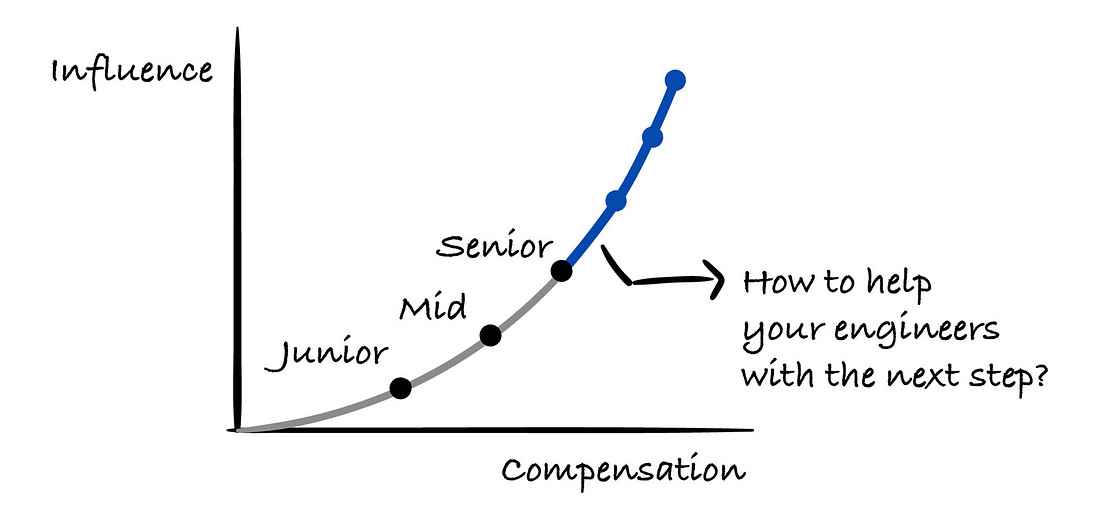
Over the last decade, he has transitioned from an individual contributor to a people-first leader who puts a big emphasis on building a great culture. He also writes Lead Through Mistakes, a newsletter on technical leadership and career growth. I had the pleasure of meeting Simone at the Codemotion conference, in October last year, where I gave a talk called: Tech Lead Rotation in Your Engineering Team. It was a pleasure chatting, and I hope to meet again in the future. Simone, over to you! People Usually Think Career Growth Is Straightforward, While in Reality, It’s Far From ThatPart of our job as leaders is looking after our team’s professional growth and trying to make it work for both them and the company. When people think about career growth, they usually picture something pretty straightforward:
That should cover it, right? Not even close. Career growth is one of the least linear things out there. There are dozens, if not hundreds, of factors involved:
You end up with this messy pile of scattered information, and you’ve got to somehow piece it together to help both the person and the company move forward. So what could you do in situations like this? I’ve picked up some tools and patterns that have helped me navigate these moments, and they might help you too. It’s Our Job as Leaders to Help Find What Growth Actually Means to Our PeopleThis article has been sitting in my head for a few years and is only now taking shape. At the time, I was leading a platform team, and the most senior engineer on the team told me at the end of a call: “I don’t see how I can grow any further here.” The call wasn’t even scheduled, not even a 1:1, so I was totally unprepared for this. I told him he was wrong, at first. That there was plenty of room to grow, that we just needed to talk about that, and we’d have found a direction. The truth was different, though. I didn’t realize it yet. We were in the middle of a hiring freeze, the teams were basically stuck, and he was trapped in a management chain that wouldn’t allow him to get promoted unless his manager (me) and/or his skip-level manager were promoted first. I had introduced the GROW framework some time before that conversation took place, and until then, I felt confident I could guide my engineers through meaningful growth conversations using it.
That conversation, however, made me realize that up to that point, I had simply been lucky, as the people I had used it with already had a clear idea of what they wanted. That’s when I understood that the framework is a great tool, but only after you’ve figured out what growth actually means for each person. As a leader, your work has an impact in two directions:
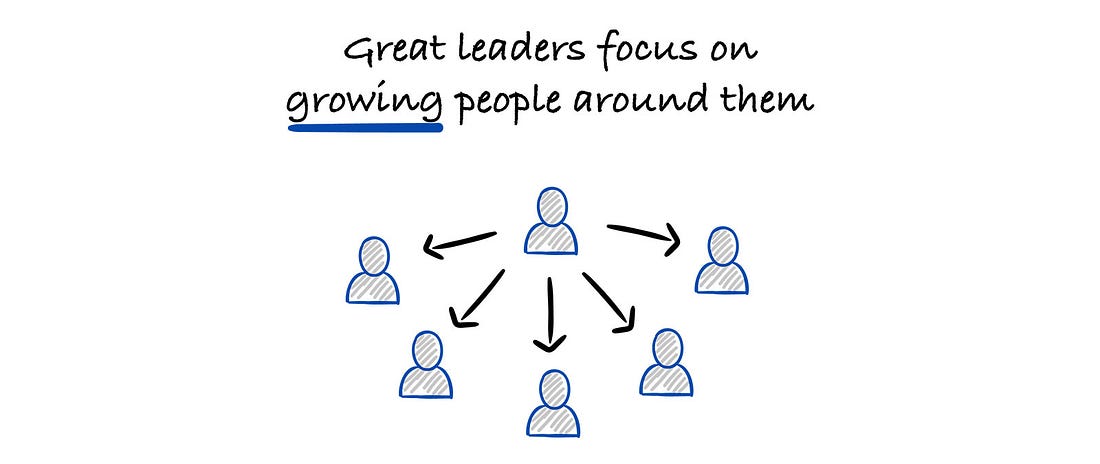
The Biggest Impact We Can Have as Leaders Is Helping Our People Grow
And that’s the kind of impact that lasts the longest: helping someone grow leaves a mark that stays with them long after your time together. For that to happen, though, you need to help people understand what growth actually means to them. And that’s often the hardest part. When we talk about professional growth, the most meaningful conversations are the ones where you help someone discover what their goal should be, even before building a growth plan. This discovery process looks different depending on at least three factors:
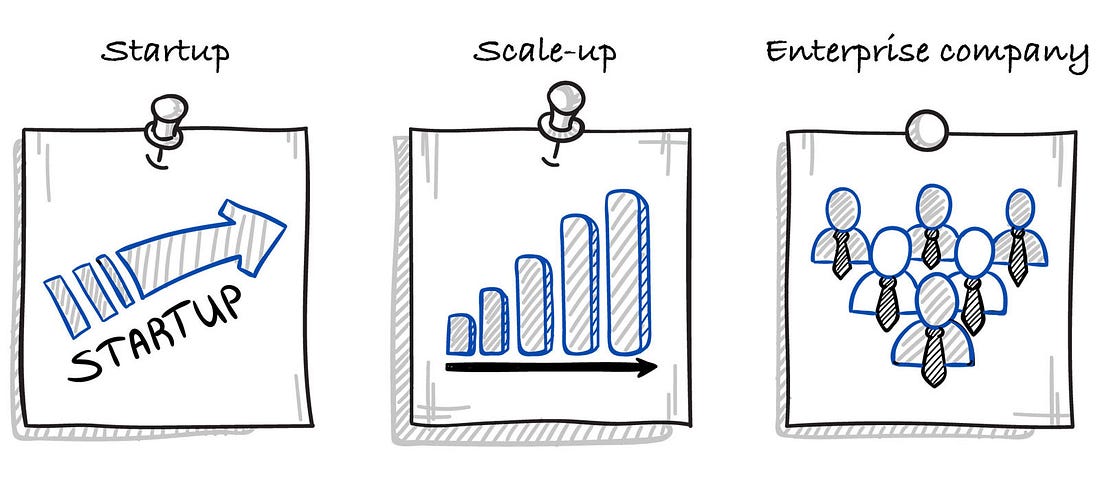
In the next sections, I’ll go through these factors in a bit more detail. How To Help Your Engineers Grow Based on the Company Size
Company size affects not just growth opportunities, but also how we think about growth in the first place. Let me paint three very different pictures. I’ve intentionally simplified company sizes into three categories, but of course, every context is unique, and these don’t fit perfectly everywhere. Helping Engineers Grow at a Startup
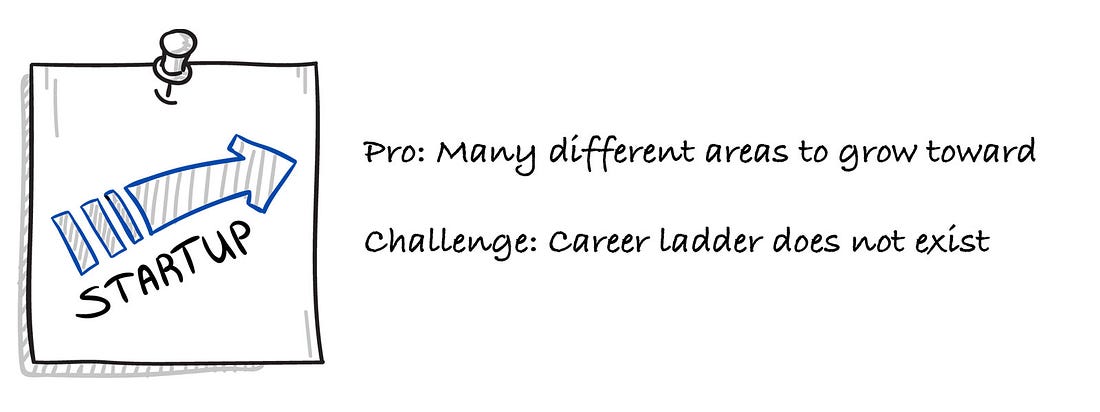
As already mentioned, when we think about growth, we often associate it with a well-defined career ladder. The reality, though, is that more than 90% of tech companies have fewer than 20 employees. In this context, growth isn’t vertical, it’s horizontal instead. We should think of it more as an expansion rather than a climb.
I’ve worked with engineers for whom such an open environment had a hugely positive effect, and with others who left after a short time because they were looking for more structure. Both responses are valid. Pros: It’s the kind of environment where someone who comes in with solid skills can easily find room to explore other areas as well. You can easily create opportunities that don’t formally exist in the org chart. The challenge: Career ladder doesn’t exist. No clear progression, no examples of being a “senior” or “staff” engineer means. Something that helped me a lot in this kind of environment is being transparent from the very beginning. Instead of pretending to have clarity about the structure, I focused the conversations on skills rather than titles. The kinds of questions that really make a difference in this context are:
Another important thing is being transparent about what the company can and cannot offer. There’s no point in making promises about things you know won’t happen, or about roles you know will never be introduced. But that doesn’t mean you can’t still help the person move in that direction. A sentence like this, for example, is far more powerful than any promise:
That last part is important: recognizing that growth might eventually mean leaving. It doesn’t always result in someone actually leaving, but being open about it helps build trust. Helping Engineers Grow at Scale-ups
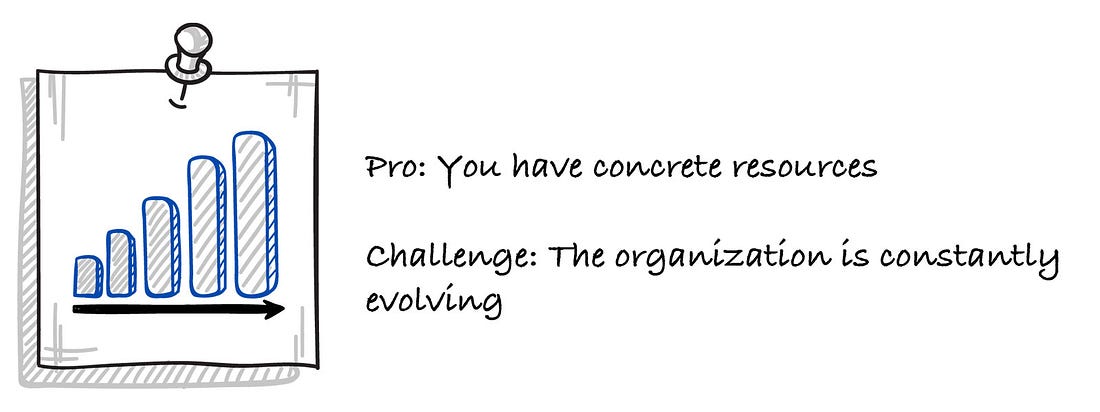
This is the stage where we start talking about teams rather than just a team. And it’s also where things start to get a bit strange. Specializations begin to emerge, but not quite specialized enough. Roles can change quickly, and positions that existed six months ago can suddenly disappear because the organization is evolving. I’ve seen Data Engineers become Platform Team Leads, not through promotion, but because the organization split and reshaped itself around new needs. Informal mentorship that worked beautifully with 30 people collapses when you scale to 300. It’s also the stage where you no longer know everyone’s name. Career conversations become critical, because the old “we’ll figure it out together” mentality no longer scales. This is the stage where these conversations also start to introduce direction: technical growth or people management? Pros: You finally have concrete resources to help people grow. Unlike smaller environments, where role boundaries are always very thin, here there are specialized teams, roles opening up, and new projects constantly starting. You have much more room to experiment, to try different roles or create hybrid positions that wouldn’t be possible in more corporate settings. The challenge: Finding your own path in an organization that’s constantly evolving. Career ladders start to take shape: they exist, but they may still be inconsistent. Opportunities are there, but they also start to intersect with office politics. Growing in this context also means focusing even more on soft skills: You can help your engineers figure out their own path by asking questions like:
Helping Engineers Grow at an Enterprise Company
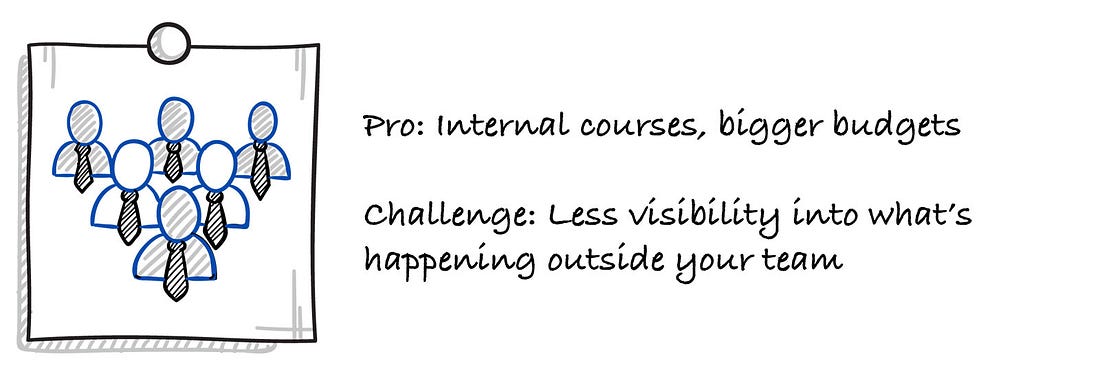
Large organizations offer something that’s hard to find elsewhere: a structured career ladder, clear and measurable progress, and specialized career tracks. This is where L1, L2, and all the other titles start to really mean something. Corporate companies undoubtedly offer more opportunities, but they also come with less flexibility. You can become a Staff Engineer, a Principal Engineer, or an Engineering Manager, but switching tracks often requires navigating internal company dynamics. This is something that can be very draining for technically-minded people. Pros: You have resources that you couldn’t even imagine in smaller environments. It’s not just about roles and opportunities: there are also internal courses, bigger budgets, formal mentorship programs, and team rotation opportunities. The challenge: With great power comes great complexity. You have access to an enormous amount of resources, but it becomes even harder to figure out the direction because you have less visibility into what’s happening outside your team. Your role as a leader is to act as a kind of translator that turns the abstract skills of the career ladder into concrete improvements that make sense within a specific domain and team. For instance, you might need to translate “strategic thinking” into something like “When you propose a design, you should also consider how it’d scale with 10x more traffic”. Questions that may help clarify direction in this context are:
Now that you understand how to help your engineers grow based on the company size, let’s define the 3 different types of engineers you’ll meet next! 3 Types of Engineers You’ll Meet (and How to Support Them)
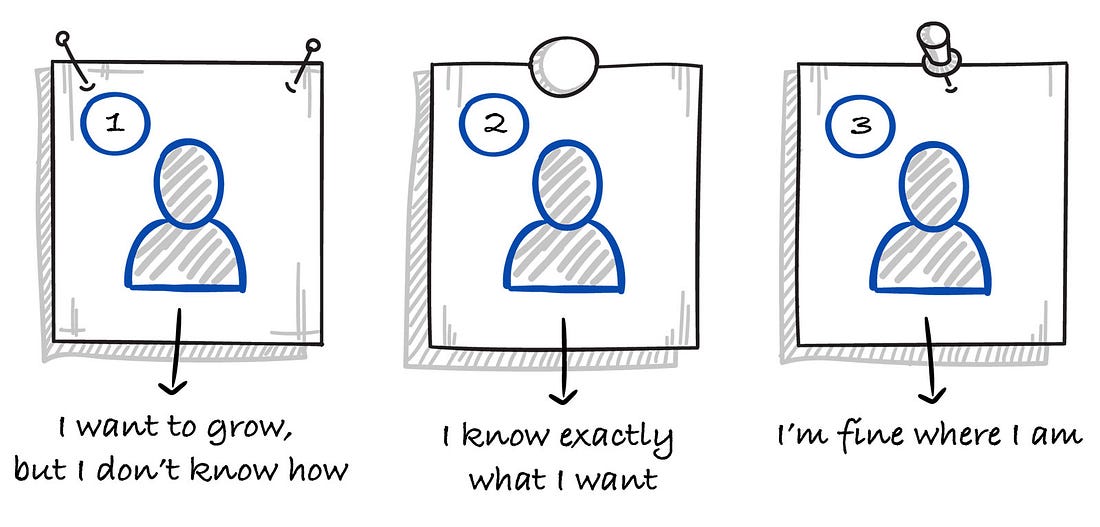
No matter the size of your company, engineers usually fall into three rough categories when it comes to growth. Each one needs a different kind of approach. Type 1: “I want to grow, but I don’t know how”
Do you know those engineers whose eyes sparkle? The ones who ask a thousand questions and have an insatiable thirst for knowledge and hunger for growth? Those people you leave at the end of the day with a single input, and the next morning you find out they spent the whole night diving deep into the topic. Often, though, that hunger for growth can become paralyzing because of the sheer number of options available and the feeling that choosing one path means giving up others that are equally interesting. The question “Where do you want to go from here?” doesn’t really work at this stage. Typically, it gets opposite types of answers: it ranges from “I don’t know” to “I’d like to go deeper into frontend because it’s needed for the project, but I really love the infrastructure side. Although, the idea of being able to manage a team doesn’t sound bad at all” (a real conversation 😅). Even though none of these paths necessarily exclude the others, you still need to line things up and figure out where to start. With time and seniority, it will become easier to find the right path independently, but at the beginning, asking questions that focus on things that have already happened rather than on the future helps identify patterns. Questions that can help are, for example:
If the answers to these questions are satisfying, there isn’t much more you need to do. It will be clear to the person themselves what the starting point should be. Type 2: “I know exactly what I want”
On the opposite side, there are those engineers who know exactly where they want to go. They’re clear about what they enjoy doing, what they don’t like, and the steps they need to take to reach their goals. In these cases, the work seems pretty straightforward: the hardest part has already been done independently. The problem, however, arises when you simply can’t offer what the engineer is aiming for: bigger projects, technologies far from your current stack, or a role that just doesn’t exist in the company right now. These are probably the conversations every leader dreads, but they’ve taught me something important:
But being honest doesn’t mean you can’t be helpful, even if it eventually means parting ways. Once it’s clear that there truly isn’t an opportunity within the team or the wider organization, pretending nothing’s wrong and hoping things stay the same is like hearing a strange noise in your car and hoping it fixes itself without taking it to the mechanic: sooner or later, you’ll pay the price. Funny enough, I actually did that with my car for over six months, only to discover this April that what looked like a simple coolant leak was actually an early warning sign that the head gasket was burning out. Better not try that with people! Trying to hold people back, or clip their wings, will only hurt both the relationship and the team’s morale. So what can you do? You can still help them get ready for the challenges ahead. For example, by supporting their development for the role they want to grow into. Type 3: “I’m fine where I am”
For a long time, I saw “no growth goals” as a failure. I used to label people as unmotivated or lacking ambition. But most of the time, there’s a perfectly valid reason behind it:
Sometimes, stability at work allows us to focus on other areas of our lives without having to juggle too many things at once. What truly matters is making sure the person is happy with their current situation. There are other situations, though, where growth is needed for business reasons: the need for deeper expertise in a domain, leadership on a project, or the inability to hire for skills that are missing in the team.
Once we acknowledge that “no” is a perfectly valid answer, often for reasons that might not be fully visible to us, what really helps in these circumstances is being honest about the fact that we’re asking the person for a favor, not offering them a gift. Which also means that a “yes” may come with conditions, and negotiating those conditions is part of the process. To Sum Up: 5 Key Tips for Supporting Engineers in the Exploration PhaseAt the end of the article, I am sharing 5 key tips that can help us support people in this exploration phase, even before getting to concrete goals. Some have already surfaced throughout the article, but I find it useful to gather them all in one place.
“Tell me about a project where you felt truly energized and engaged.” This question reveals natural interests and strengths much better than “What are your career goals?”
Instead of relying only on 1:1s or isolated conversations, try to observe patterns over time: What lights them up or kills their energy? What do they repeatedly mention? What do they volunteer for without being asked?
Many engineers tie their identity to a specific path (e.g., “I am a backend engineer”) and feel guilty about wanting to change direction. Help them see that it’s not their role that defines them, but their values and the kind of impact they want to make.
Sometimes people have the answer right in front of them, they just need a little nudge to see it. Making patterns explicit is often that nudge.
Before someone fully commits to a growth path, help them test it. Small experiments beat big commitments when someone is unsure. Last wordsSpecial thanks to Simone for sharing his insights on this very important topic! Make sure to follow him on LinkedIn, and also check out his newsletter Lead Through Mistakes, where he regularly shares interesting articles! Liked this article? Make sure to 💙 click the like button. Feedback or addition? Make sure to 💬 comment. Know someone that would find this helpful? Make sure to 🔁 share this post. Whenever you are ready, here is how I can help you further
Get in touchYou can find me on LinkedIn, X, YouTube, Bluesky, Instagram or Threads. If you wish to make a request on particular topic you would like to read, you can send me an email to info@gregorojstersek.com. This newsletter is funded by paid subscriptions from readers like yourself. If you aren’t already, consider becoming a paid subscriber to receive the full experience! You are more than welcome to find whatever interests you here and try it out in your particular case. Let me know how it went! Topics are normally about all things engineering related, leadership, management, developing scalable products, building teams etc.
You're currently a free subscriber to Engineering Leadership. For the full experience, upgrade your subscription.
|







Similar newsletters
There are other similar shared emails that you might be interested in: