The Missing Variable in Most Content Strategies
- Carilu Dietrich from Hypergrowth Leadership <carilu@substack.com>
- Hidden Recipient <hidden@emailshot.io>
The Missing Variable in Most Content StrategiesPlanning content effectively in an AI-saturated world
AI has made it easier to create content quickly. But the core challenge hasn’t changed: How do you give buyers exactly what they need at the right stage of their decision and stand out while doing it? What content will actually perform? Shannon Prager, a former colleague of mine, has led several major content strategy engagements with me, auditing what exists, identifying what works, and building prioritization frameworks that accelerate pipeline impact. Below, she shares the strategic lens behind that work. In a follow-up post, we’ll share specific planning templates. Devising a Content Strategy in an AI-First WorldBuyers are skeptical. AI has flooded the market with interchangeable messaging. Decisions are shaped quietly, across channels, long before a sales conversation begins. Yet many teams still plan content around a predictable, linear funnel, regardless of market dynamics. That’s a problem. Content strategy doesn’t just shift by stage. It shifts by market context. Are you:
Each scenario changes what buyers need to see, and when. This framework helps align content to the right stage, at the right time, based on the type of market you’re in, so your strategy drives pipeline, not just fills a calendar. Why The Same Funnel Doesn’t Work EverywhereWe often talk about content in terms of top, middle, and bottom of funnel. But that oversimplifies reality. What actually changes isn’t just the funnel. It’s the buyer’s belief state. When I say New Concept, New Paradigm, or Established Market, I’m not describing how innovative your product is. I’m describing how much the buyer’s thinking has to move.
In AI, you can see all three at once:
Each market type changes what content moves a deal forward.
If your content doesn’t match the buyer’s mindset in that context, it will miss, no matter how polished it is.
|



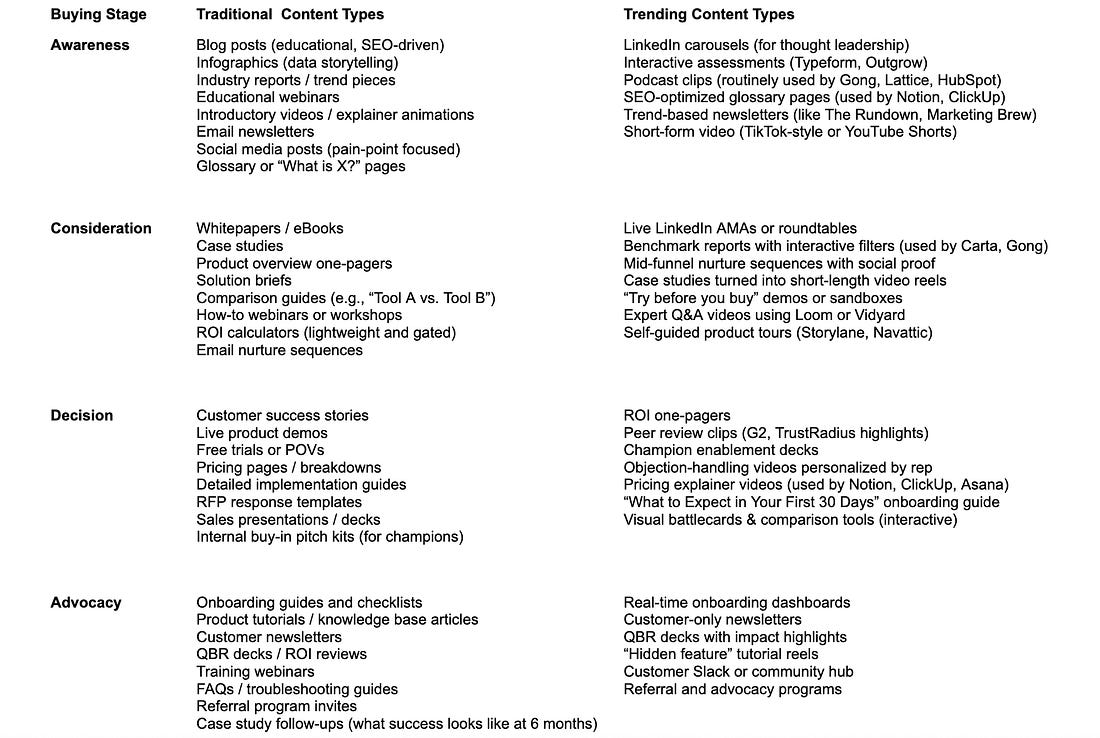 |
Match the Journey to the Market
Too many teams create strong content in a vacuum and wonder why it doesn’t convert. Content doesn’t fail because teams aren’t producing enough of it. It fails when it’s planned without context.
Before you build the next asset, ask: What does our buyer need to believe right now, given the market we’re competing in?
When content aligns to:
the buyer’s mindset
the stage of their decision
and the maturity of the market
it stops being background noise and starts moving deals.
The teams that win won’t create the most content. They’ll plan with intent, say fewer things more clearly, and meet buyers where decisions are actually made.
If momentum feels slow, the answer usually isn’t “produce more.” It’s “plan smarter.”
Shannon Prager is the CMO Matic, helping redefine how AI and healthcare come together, giving medical providers time back and helping care teams work smarter. She also advises high-growth startups and provides marketing and content strategy support. You can find her on LinkedIn or at sprager@leaditmarketing.com
Carilu Dietrich is a former CMO, most notably the head of marketing who took Atlassian public. She currently advises CEOs and CMOs of high-growth tech companies. Carilu helps leaders operationalize the chaos of scale, see around corners, and improve marketing and company performance.
You're currently a free subscriber to Hypergrowth Leadership. For the full experience, upgrade your subscription.
| ||||||||||


Similar newsletters
There are other similar shared emails that you might be interested in: