📚 Books I read in November 2025
- Sergio Visinoni from Sudo Make Me a CTO <makemeacto@substack.com>
- Hidden Recipient <hidden@emailshot.io>
Hi, 👋 Sergio here! Welcome to another free post from the Sudo Make Me a CTO newsletter. If you prefer to read this post online, just click the article title. As this is a free newsletter, I do immensely appreciate likes, shares and comments. That's what helps other readers discover it! 📚 Books I read in November 2025One of the things I love most about books? One book usually leads to others, which in turn lead to others... in an infinite thread of surprises and joy. Even then they're not all masterpieces.
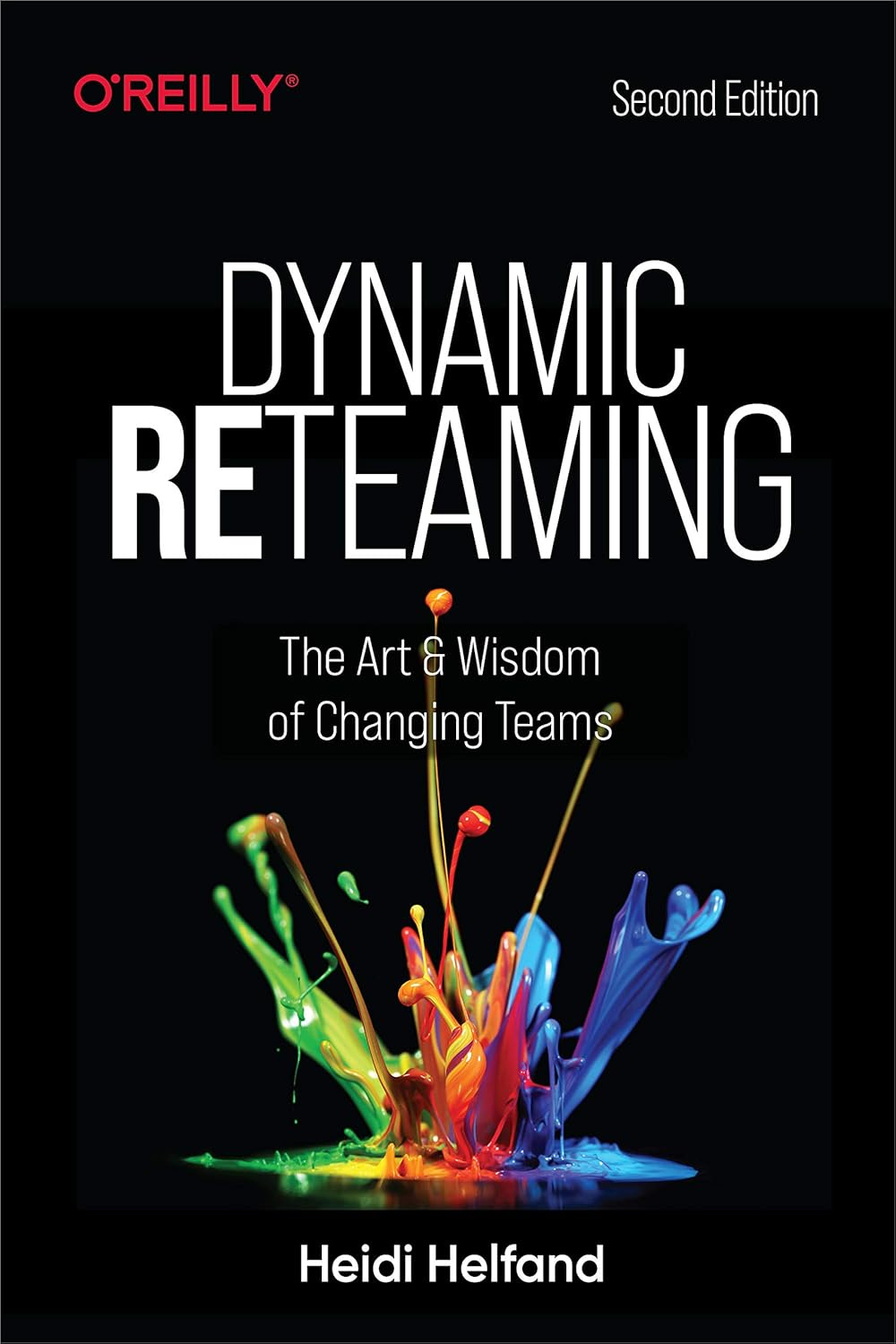
Reading is calisthenics for your brain. Reading good books is a great way to broaden your knowledge and perspectives. Reflecting on the books I read every month helps me cement the key learnings from each one of them. What better than recommending someone else a good book? Recommending two, three, or five good books! Here we are with the November edition of the books I read last month! If you end up reading one of them, please let me know in the comments section. 💫 Book Highlight: Dynamic Reteaming by Heidi Helfand
I had heard about this book a few times in the past, but what convinced me to read it was noticing that it was mentioned a few times in the Architecture for Flow book by Susanne Kaiser. BTW, I really enjoyed that book, in case you missed it.
Given how much I liked Kaiser's book and how it inspired me—among other things—to pick up Wardley Mapping, I thought it was finally time to pop it to the top of my reading list and went through it as one of my three books for November. I read the second edition, which came out recently. My overall verdict: it’s a good book, but it didn’t impress me. While most, if not all, of the content is relevant and well articulated, I rarely found anything truly novel in it, something that would make me stop and think. This is as much a feature of the book as it is a feature of the reader. I genuinely believe the content is good, but I didn’t learn a ton from it. I found the first part on introducing the different patterns a bit too long, but the second part has been significantly more enjoyable for me to read. Particularly chapters 11 to 14, where Helfand describes more of the how of transformation and reorganizations, and provides a lot of helpful frameworks and approaches on how to navigate those changes effectively. To give the book justice, I’m probably not the main target. I had the “luxury” of having to go through a whole bunch of reorganizations throughout my career. Sometimes on the receiving end, sometimes on the other end, and very often in between: working together with the senior leadership to make things happen. While we didn’t necessarily speak the language of the patterns identified by Heidi Helfand, we definitely used many of the approaches described in the book. It’s often said that the value of defining patterns lies more in their ability to formalize common knowledge and good practice than in coming up with novel concepts. In other words, patterns are generally more descriptive than prescriptive. In that sense, the book does a good job of putting names to commonly used practices of team reorganization and evolution. The part that I may have found the most interesting is the idea of Team Choice Marketplace, mentioned extensively in the book, to which the entire Appendix A is devoted. It might sound weird and unfairly dismissive to state that my favorite part of a book was the appendix, but sometimes that happens. It’s an idea that really caught my attention, particularly because I’ve never really used it in such a form. Would I recommend this book? It depends. It depends primarily on your trajectory and your current situation. If you’ve been through a lot of not-completely-catastrophic reorganizations, you might find here a little more than a good way to reflect back on those moments and recognize things you’ve done well and those you could have done better. If, on the contrary, you’re relatively new to the ins and outs of team reorganization, this book would be a great resource, as it’ll give you plenty of references and ideas on how to approach them going forward. Personally, this is a book I’m happy I finally went on to read, as it helps me refine my vocabulary around the topic. I also believe it’s one of those resources I’ll refer back to when the need arises to apply its core concepts. More of a reference manual than a conceptual book, if you get what I mean. 📚 Other Books I Read in NovemberEntre Deux Mondes by Olivier Norek
That’s it. With Entre Deux Mondes, I’ve read all the books written by Norek to date. What a shame, I really love them. Entre Deux Mondes is no exception. It’s another of those works that leave me with a profound sense of admiration and respect for the author. As usual, to write the book, Norek spent a lot of time in the environment that serves as its main background. Except that this time we’re talking about what became known as the jungle, a barely tolerated immigrant and refugee camp in Calais¹. Apparently, Norek spent a significant amount of time in Calais and in the jungle. Interacting with the refugees there, learning about their lives and their goal: crossing the British Channel and landing in the UK. He also spent a significant amount of time with members of various NGOs and the local police. The result of his personal investigation is a dark, moving, and obscenely well-written book called Entre Deux Mondes, meaning “between two worlds.” I’ll pass the details on the plot and focus on the main point. This book is dark, profoundly dark. It’s a powerful, and somewhat shameful, reminder of the conditions many of our fellow humans have to endure on this planet, whose only fault is to be born in a country where a decent life of peace and safety is largely impossible. While the jungle, the place, was dismantled about a decade ago, Norek gives us a good reminder that we should not take a decent life for granted. I don’t have an easy solution to offer for that without falling into populist claims, but I wholeheartedly recommend every decent human person on this planet to read Entre Deux Mondes and have a genuine conversation with themselves on how we could make this place just a tiny fraction less shitty for people in dire situations. La Moustache by Emmanuel Carrère
Carrère, along with Norek, is one of my favorite authors of recent months. What's funny is that the only thing they have in common is that they’re impressive French writers. And that’s it. They seem to be otherwise completely different. La Moustache is the first fiction book ever written by Carrère, but for some reason, I could not get my hands on a copy until recently. It’s a short book, and I devoured it in a couple of days. It’s an engaging book. It’s also, and more importantly, a disturbing book. At some point, I realized that, as I was reading, I had the famous Queen song “I’m going slightly mad”², playing in a loop in my mind. Somehow, my brain had surfaced it from memory to go along with the increasingly disturbing story of the main character in La Moustache. What is this book really about? It’s the story of how an apparently insignificant event in one’s life can open the abyss of madness. How manipulation could be hiding everywhere, and how trusting our own mind can feel incompatible with trusting other people's words. While the main character engages in a physical journey, the reader is mainly engaged with an inner journey in the main character’s mind. Exploring his doubts, convictions, and contradictions. His unpredictable mood swings are so well described that you might feel you’re going down a dangerous rabbit hole as you read them. This early Carrère book showed his insane ability to marry engaging narrations with surprising introspections. Reader, be warned: the book is really disturbing. The more it progresses, the more you’ll battle with the need to continue reading and the desire to help the main character out of the darkness they are falling into. Read it only if you’re capable of keeping a distance between what you read on the page and your own personal emotions. I loved it, but I’m well aware that this won’t be the same for most people. I don't say that to sound elitist³, to suggest that only the highly initiated will enjoy it. It’s just a recognition of taste and different levels of tolerance with regard to other people’s suffering in a fictitious story. Help keep this newsletter freeI love writing this newsletter, and I intend to keep it free forever. If you want to support my work, you can engage with me in one of the following ways:
If your needs fall into a different category, such as newsletter collaborations or sponsoring, please reply to this email or schedule a free call via this link. 1 See this Wikipedia page for more info on the jungle: https://en.wikipedia.org/wiki/Calais_Jungle 2 If you’re unfamiliar with the song, you can fill the gap at this page: https://en.wikipedia.org/wiki/I%27m_Going_Slightly_Mad. If you're curious about having music playing in my mind, that's something that happens very often, almost always. I guess that's normal. Please do not try to convince me it's not! 3 In hindsight, isn't this the most elitist way of saying it? Sudo Make Me a CTO is a free newsletter edited by Sergio Visinoni. If you found this post insightful, please share it with your network using the link below. If you or your company need help with one of the topics I talk about in my newsletter, feel free to visit my website where you can schedule a free 30 minutes discovery call. I'd be delighted to investigate opportunities for collaboration!
|








Similar newsletters
There are other similar shared emails that you might be interested in: