The Year of Invisible AI
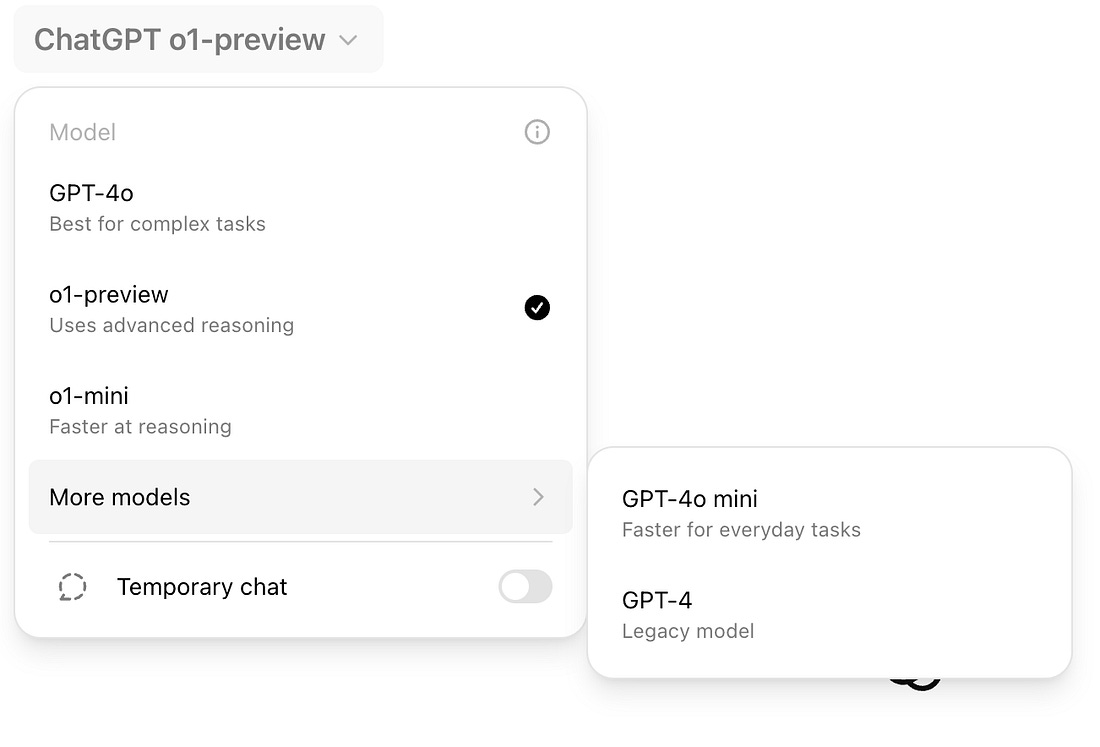
Weekly writing about how technology and people intersect. By day, I’m building Daybreak to partner with early-stage founders. By night, I’m writing Digital Native about market trends and startup opportunities. If you haven’t subscribed, join 70,000+ weekly readers by subscribing here: The Year of Invisible AIThe final prediction in last month’s 26 Predictions for 2026 was this: “For AI apps, UI becomes the differentiator.” The horserace in models will continue, but the big battles in applied AI will take place within product design and workflows. A new technology comes with challenges: how do you package unfamiliar tech in familiar ways, ways that are simple yet powerful, intuitive yet innovative? Certainly, interfaces need to improve on this:
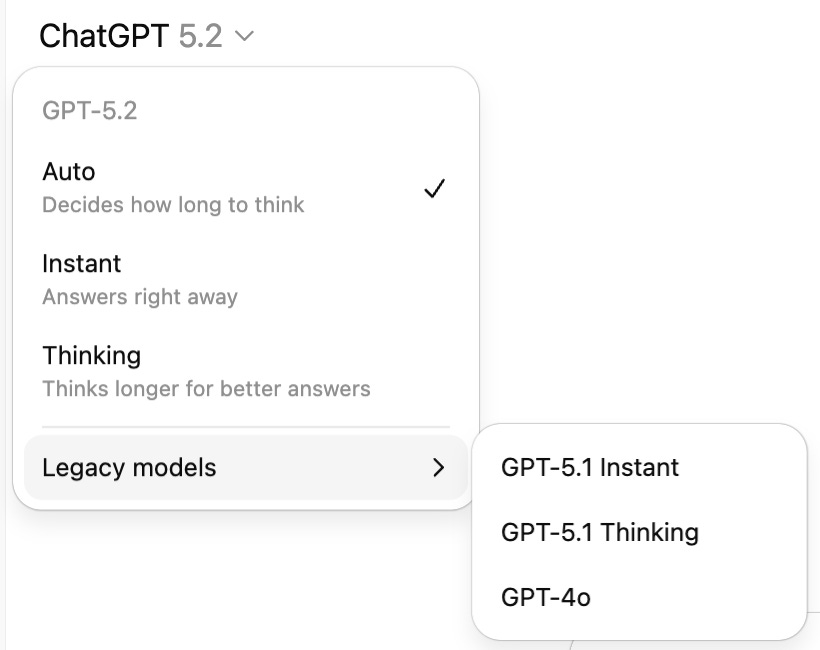
Shout it from the rooftops with me: “Your users don’t care what model they’re using.” Why should users be burdened with these decisions? Pick the best model for the job to be done, period. Side note: I wish OpenAI had used its nickname for 4o, Strawberry, as the official name. At least that’s something familiar to people 🍓 , versus the inscrutable 4o. Anyway: in OpenAI’s defense, the screenshot above is dated. You can see here that OpenAI has improved its interface; confusing model names have been replaced with clearer descriptions, which is a start:
AI interfaces are definitely getting better, but they have a long way to go to be able to translate powerful, cutting edge capabilities into intuitive and beautiful products used by billions of people. The challenge is especially acute in enterprise, where workflows are bespoke and complex. My general view: it’s hard to teach an old dog new tricks. Most people don’t want to change the familiar, comfortable ways in which they work. So if you’re building AI for workers, make sure you build along the current and not against it. A good rule of thumb: if you’re introducing people to a new technology, you should change as little as possible as possible about how and where they work. The best AI products meet workers where they’re at. Case Study: SandstoneSandstone, one of our Daybreak portfolio companies, comes out of Stealth today with a fresh $10M in funding led by Sequoia. Sandstone offers a good example of user-centric, well-designed AI. Sandstone is building AI for in-house legal. In-house legal is a roughly $30B global market (Source: McKinsey) and in-house is growing quite a bit faster than the broader law market. Tailwinds abound: companies are facing more complex regulatory landscapes; compliance demands seem to increase every year; and cost pressures incentivize moving legal spend in-house. Lawyers are also increasingly seen as central to strategic decision-making. There’s a reason why Gerry was always at Logan Roy’s side.
All in, the number of in-house counsel in the U.S. has roughly doubled in the last 15 years. This is a massive chunk of legal spend. But, as you’d expect, in-house legal is rife with headaches and inefficiencies. Data is siloed and messy. Work can be frustrating and repetitive: lawyers end up buried in procurement tickets and monotonous redlines. And the job has become much more reactive (e.g., getting back to Rachel in Marketing on approving a social media post) as opposed to proactive (e.g., strategic planning for a major new regulation). Sandstone’s insight is to meet in-house teams where they are, becoming the central nervous system that unifies data and injects AI into tools people are already using.
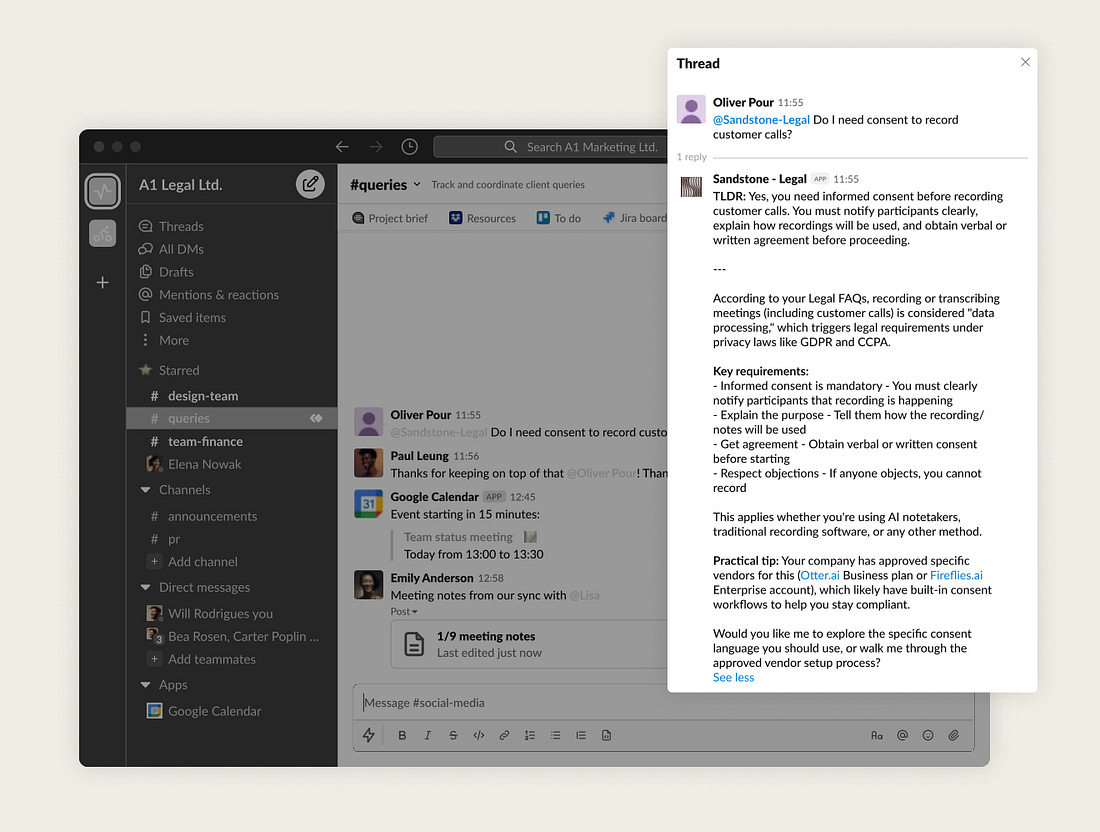
A huge mistake in applied AI, in my opinion, is what I’d call showing off. Founders and engineering teams tend to over-build, flexing the bells and whistles of a new model while alienating the customer. In most cases, your customer isn’t someone who knows or particularly cares what a GPT is. They probably just want to sort through their endless stack of contract reviews, NDAs, and redlines, then go home. Sandstone gets this right. They have 30 integrations, plugging into Slack, Salesforce, Gmail, Jira, HubSpot, and so on. Here’s an example of a Slack integration at work:
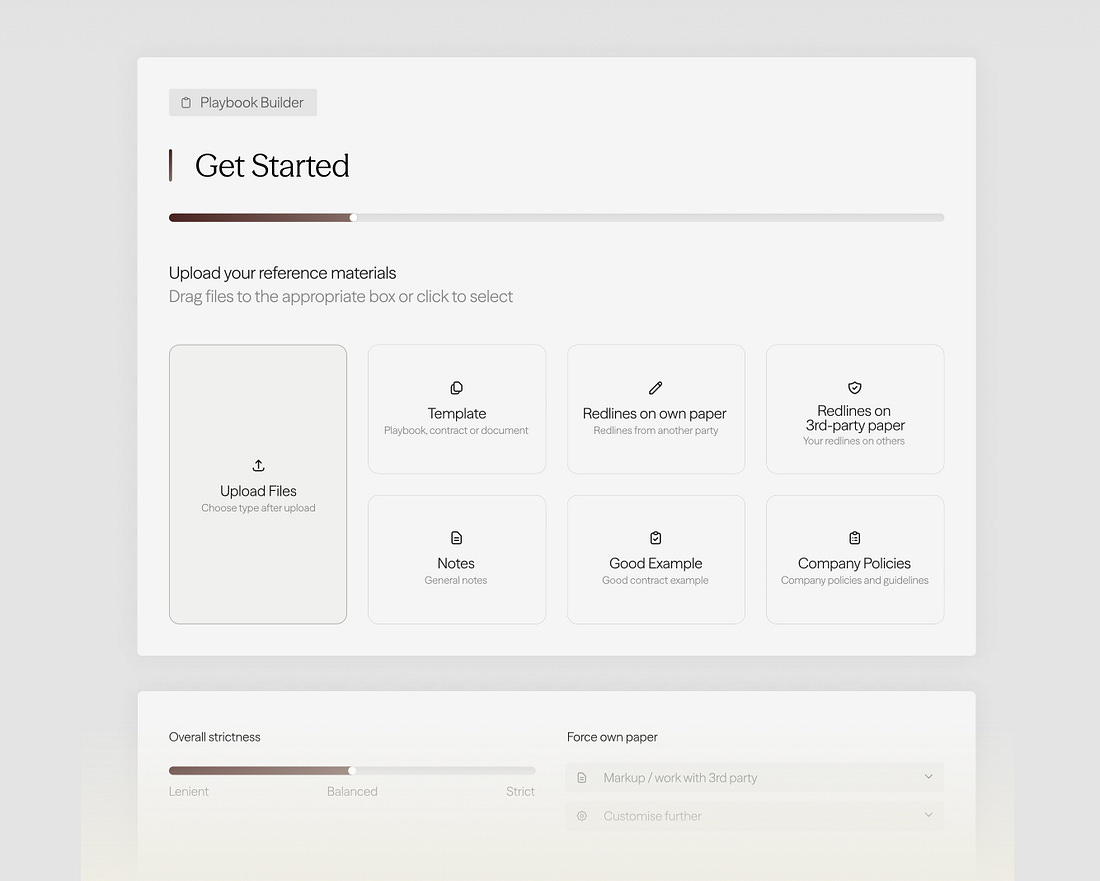
This is pretty seamless. You can picture anyone at the company, legal or non-legal, interacting with Sandstone in this way. And for in-house teams themselves, they can build playbooks that train Sandstone on how the team likes to do things. As a result, Sandstone gets smarter and better over time.
Imagine I run a CPG brand called Rex’s Chex. We have a dozen people on our legal team. A Day at Rex’s Chex Legal, Pre-Sandstone
A Day at Rex’s Chex Legal, Post-Sandstone
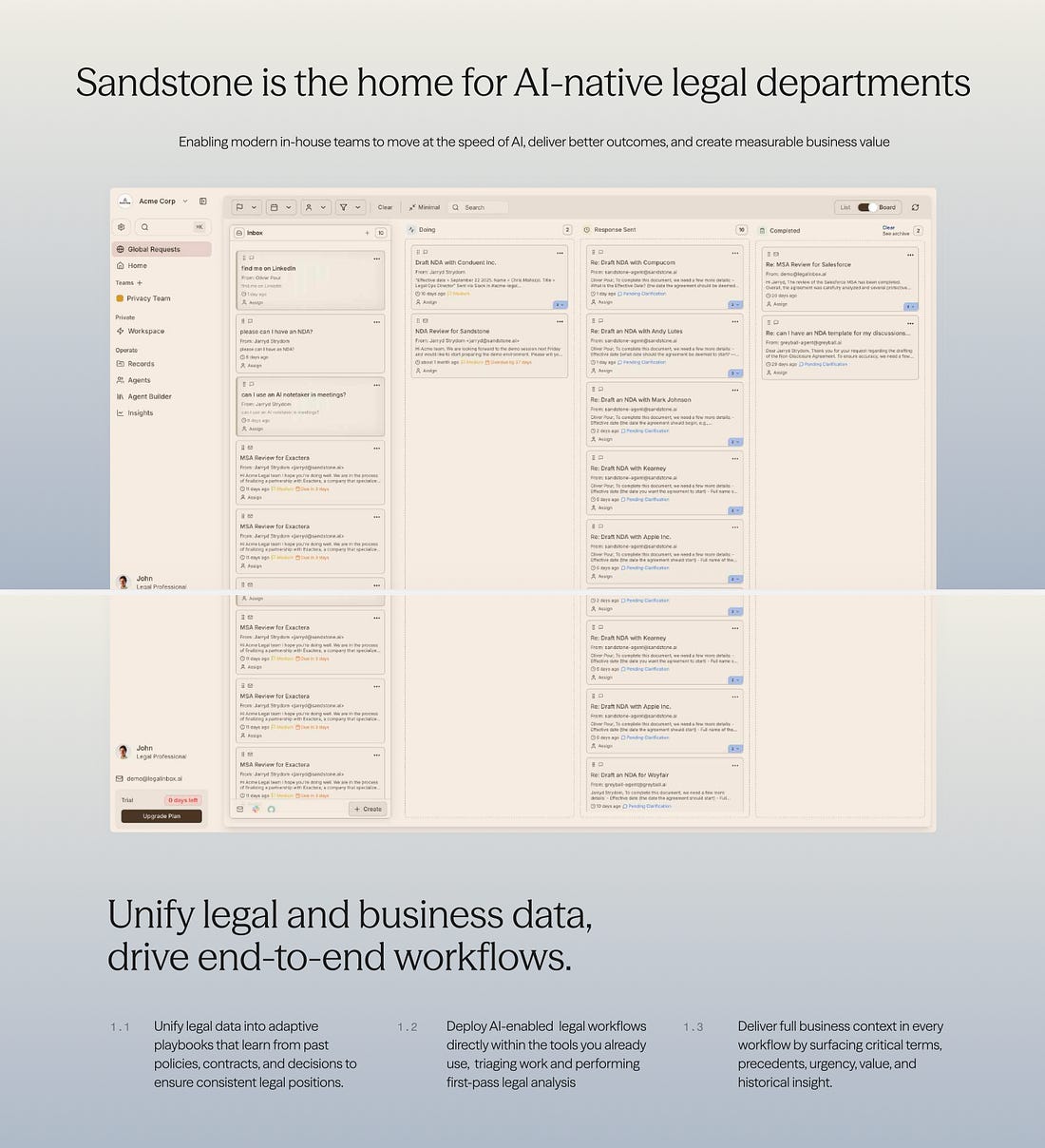
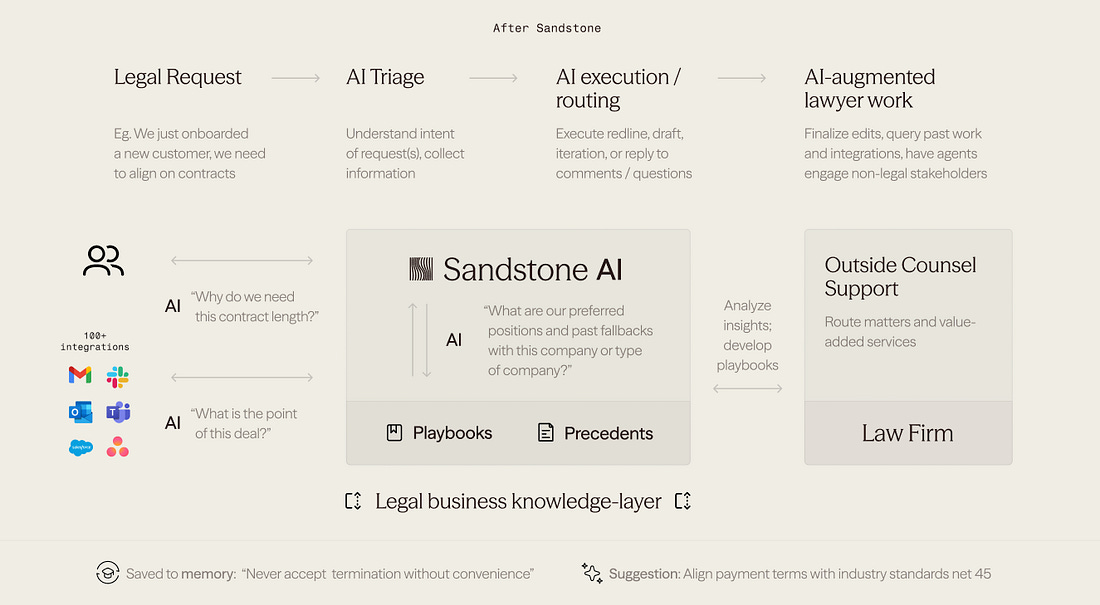
This is oversimplified, of course, but it gets the point across. Agentic workflows should be equivalent to having a junior analyst at your fingertips, at all times. They should arm you with data and context instantaneously, shifting your time from busy work to high-value approvals and key judgment calls. Here’s how Sandstone visualizes its workflows:
Yes, Sandstone does introduce a new product to the stack. But it positions that product as the one product to rule all products, the central source of truth and the starting and ending place for every workflow. Work still gets done in all the familiar tools; Sandstone just acts as the intelligent connective tissue tying everything together. Final Thoughts: The Year of Invisible AII think of 2026 as the year of invisible AI. AI gets seamlessly integrated into our workflows, so much so that lines blur completely between AI workflows and our old ways of working. Tagging Sandstone in Slack for a legal question should feel no different than tagging your legal colleague. Having Sandstone appear while you edit a Word Doc, suggesting key changes, will be second nature. We’ll forget how painfully and slowly we used to do things. As Jevons Paradox would argue, automating legal work will also probably increase the size of in-house legal: as legal expertise becomes a more accessible good, demand will go up. Jaya Gupta wrote a great recent piece on Context Graphs. Systems of record are a multi-trillion-dollar ecosystem: Salesforce for customers, Workday for employees, SAP for operations. Systems of record store canonical data, which powers the workflow and creates a lock-in. Jaya argues that with AI, something else matters: context. Context is the messy process explaining how and why a decision gets made. This isn’t discrete data that lives in a field within a CRM. This is valuable, nuanced understanding of how a company operates. For instance, how does Rex’s Chex like to handle co-man agreements? That’s more subtle and complex knowledge than a system of record would store. In Jaya’s wording:
Context is why products like Sandstone can be so transformative for the workers they serve. This is clearest in Sandstone’s “Playbooks” feature, which directly guides teams to provide context that betters the Sandstone product. A good B2B AI product shouldn’t just automate grunt work; it should learn about how an organization functions, then develop contextualized, ever-improving workflows to execute tasks. Well-built applications should compound over time, with products gathering context that makes future decisions faster and smarter. The promise of invisible AI isn’t creating a new way of working, but rather creating a better version of working in the ways that are familiar and comfortable to the user. Sandstone HiringNick, Jarryd, Liam, and the team at Sandstone are hiring across nearly every function. If you’re interested in joining them here in New York, check out their Careers page here for open roles. You can also email Nick at nicholas@sandstone.ai 📬 Thanks for reading! Subscribe here to receive Digital Native in your inbox each week:
|








Similar newsletters
There are other similar shared emails that you might be interested in: