I Used Three Travel Businesses — and Learned Three Different Lessons
- Brent and Michael Are Going Places <brentandmichaelaregoingplaces@substack.com>
- Hidden Recipient <hidden@emailshot.io>
I Used Three Travel Businesses — and Learned Three Different LessonsIf online reviews don't mean anything, how do you tell what's good?
This article contains affiliate links through which we may earn a commission from purchases. These days, travel is big business — with a million different travel businesses. But how do you decide which ones to use? Here are three recent experiences I had with three different travel companies from which I learned three different lessons. Problem is, these lessons sometimes contradict themselves. This has forced me into a kind of existential crisis: when it comes to travel, how do you pick the best company to do business with? When all is said and done, I’ll try hard to leave you with some kind of overall travel wisdom.
I Made a Claim with Genki Travel InsuranceI regularly write about health and travel insurance for nomads, expats, and long-term travelers — and I have long strongly recommended policies offered by a company named Genki Insurance, which Michael and I use. They offer traditional “travel insurance” (which assumes you have a place to go where you’re covered for chronic or long-term care) and also full “international health insurance” (which means this is your only policy and covers all your healthcare needs). Michael and I have made a few small claims with Genki before, through their AirDoctor app, which made the whole process really easy. But maybe it was too easy, because the company has discontinued its association with the app, claiming it was driving up frivolous claims. They also raised their prices and put caps on their payouts (which used to have no maximums) — in response to exploding healthcare costs worldwide, they say. A year ago last October, I had a very painful kidney stone on board a cruise ship and had to be taken to a hospital in Tromsø, Norway, for three days. I paid for the medical care on the ship ($1500 USD) out of pocket (and, upon furnishing receipts, was promptly reimbursed by Genki within a week). But I merely gave the hospital in Tromsø my insurance information upon entry, and I didn’t notify Genki, even after I’d been cleared to leave three days later.
Later, the hospital billed Genki directly ($3345), who then forwarded the bill on to me, saying I had not followed their proper procedure. DR-WALTER — the German company that handles Genki’s payouts — said they could still reimburse me, but I would first have to pay the hospital out of pocket and submit the proper documentation. I was wary that I would be reimbursed, but the bill needed to be paid regardless, so I ended up wiring thousands of dollars to a random number somewhere overseas, in a process that was fairly complicated and very nerve-wracking. The folks at the hospital were helpful — and, of course, they spoke perfect English — but they also informed me that the Norwegian medical system simply doesn’t offer “itemized” bills, as required by DR-WALTER. However, they sent me a printed explanation to give to my insurance. Was DR-WALTER going to use this loophole to avoid paying me? I submitted proof of payment and the other necessary forms via email. At this point, DR-WALTER informed me that they required the original bill from the hospital in Tromsø. Which I had — because I keep everything — but I’m a nomad, and the bill was stored somewhere in a file back in America. Here we go! I thought. This is how they’re going to weasel out of paying me! But DR-WALTER also said I had two full years from the incident to submit the necessary bill, and when I finally returned to America this past January, I sent it in — using as secure an international shipping option as possible (Priority Mail Express, which cost $85). All this time, I stayed in close touch with DR-WALTER, and sure enough, when my documents arrived, they promptly paid me in full (but the only payment option for Americans like me is through Revolut, which required me creating an account there). Lessons learned:
I Got a Hotel Day-Pass Using ResortPass.comHere at Brent and Michael Are Going Places, we never accept comps or freebies in exchange for coverage: if we recommend something, it’s solely because we genuinely like it. That said, we are open to pitches of ideas from publicists (and we get plenty — dozens a week). And we also very occasionally accept travel products for review (but with absolutely no guarantee of any coverage at all). Recently, a publicist pitched a small travel item, which I ended up using. In gratitude, she said she wanted to offer me a $500 credit at another company she did publicity for, ResortPass.com, which offers “day-passes” to resorts and spas all around the world. This seemed like kind of a journalistic grey area. She wasn’t necessarily suggesting I write about ResortPass.com — she claimed it was a thank-you gift. But come on: she’s a publicist, and I’m a travel journalist. On the other hand, it was a kind of travel product, and if I liked it, maybe I could eventually write about it. Was that so wrong? In the end, Michael and I were visiting friends in San Francisco, both of whom have cancer, so I decided to use the credit to treat everyone to a day at a local spa. Unfortunately, using the credit on their website turned out to be really confusing — and their customer support was very frustrating too. Even worse, they knew I was a travel journalist. I couldn’t help but think: if this is how they treat people they’re trying to suck up to, how do they treat everyone else? After a couple of frustrating hours, I finally managed to book a day at a nearby spa. I received both email and text confirmation from ResortPass.com. But when we showed up at the spa (in a posh hotel), they had no record of the reservation. Worse, when I talked to the manager, he said the hotel had changed ownership over a year ago and had terminated its contract with ResortPass.com — something he said they’d repeatedly told the company. So no spa day for my friends with cancer. (But we stopped at Trader Joe’s on the way home, and ended up having a lovely impromptu picnic.) When I recounted my experience to my contacts at ResortPass.com, they said, “Your experience is completely unacceptable and does not reflect the ResortPass standard.” And the fact is, the company's online reviews are fairly decent, as is much of its other press. But my experience also isn’t unique — with lots of reports of bad customer support, and other people sometimes showing up to find there is no reservation. Lessons learned:
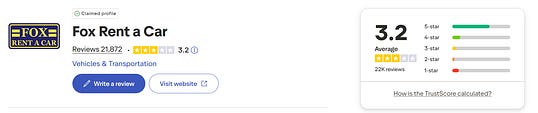
We Regularly Rent Cars with Fox Rent a CarMichael and I have been digital nomads for nine years now, and we generally come back to Seattle, our former-home in the United States, for visits once or twice a year. Because it’s America, we always need to rent a car. And because we rent for up to a month at a time, I’ve always looked for good deals, and the lowest price, by far, has always been a smaller company named Fox Rent a Car, with locations around the country, including Seattle. Plus, unlike some companies, Fox allows you to add a spouse as an extra driver for free (at least at all U.S. locations) — and they’ve never asked for proof or made the slightest fuss about the fact that we’re a same-sex couple. (Some rental companies allow you to add a spouse for free if you sign up for their loyalty program, although sometimes you need to do it in advance, and California and New York mandate that spouses be able to drive for free.) In the nine years we’ve been renting cars from Fox, we’ve had two issues: a higher-than-quoted fee and a “manager’s special” that was deceptive, resulting in a ridiculously oversized car (which we declined, resulting in a considerably more expensive smaller car). In both cases, I contacted the manager, and he conceded my point and reversed the charges. So our experience has been uniformly positive. But that isn’t the case with a lot of other renters — at least according to online reviews. Those reviews are mediocre at Trustpilot (3.2 out of 5) — and downright disastrous at Yelp and ConsumerAffairs, where they’re 1.6 and an eye-popping 1.1 out of five, respectively. And these numbers are the result of thousands of reviews.
The complaints run the gamut, but they mostly boil down to unexpected fees and poor customer service. So what gives? How can our experience have been so good while everyone else’s is so bad? Have we simply been lucky? We’ve definitely had bad experiences at other car rental companies. The truth is, looking at all these horrible reviews has made me suspicious. The price is still so much better than other companies’ that we’ll probably continue renting with Fox. That said, I have a funny feeling in my gut that I didn’t have before. Lessons learned:
So What Does It All Mean?I said at the beginning of this article that the lessons I learned from all these experiences sometimes contradicted each other. When it came to online reviews, the results were all over the place — fairly good for a company I personally found bad, and really bad for a company I’ve found good. So are online reviews worthless? Not entirely, but they’re just one piece of information. It also matters what’s in the reviews, so you should read them closely, including the lower-rated ones. Are they just a bunch of cranks, or do they have what seem to be legitimate gripes? Is there a common thread? As for the five-star reviews, it’s good to get into the habit of reading between the lines. Do they sound legit — or do they read like they were written by the business itself or its friends? Might they have been artificially inflated by personal contact with the business? This is often the case with smaller businesses. All that said, I think the most important factor in determining whether you should patronize a particular business is your own personal experience with that business — or the personal experience of people you know and trust. And if you don’t have personal experience, trust your gut. If something seems too good to be true, it probably is — and if something seems “off,” it almost certainly is. In terms of importance, I would rank the different factors this way:
In the end, though, I concede this is more than a little unsatisfying. When it comes to choosing a travel business, there is still — and I suppose there always will be — a big element of mystery and plain old random chance. Then again, that’s also true of travel itself. Brent Hartinger is a screenwriter and author. Check out my new newsletter about my books and movies at www.BrentHartinger.com.
Using the above affiliate links will cost you nothing and help support our newsletter. You can also support us with a one-time donation of any amount here:
|









Similar newsletters
There are other similar shared emails that you might be interested in: