| TL;DR | 👀 Inside Octopus Energy’s No-HR model: What it actually looks like | ✅ Want a No-HR model? 5 tests to see if you’re ready | 🎧 Listen to the newsletter here | This newsletter edition is brought to you by Rippling 💛 | |
|
| | | Which Strategic HR Archetype are you? | Discover what you’re brilliant at, what’s holding you back and your exact next step. Free. 7 minutes. | |
|
|
|
| | | Question: If HR isn't running the performance cycles, action planning from eNPS, the ER process…what are they actually doing all day? What does their team even look like? | | | | Head of People |
|
| Inside Octopus Energy’s No-HR model: What it actually looks like | In the previous newsletter, we learned from Cynthia Chan (Head of People Ops) at Octopus Energy that their HR team doesn’t have People Partners. They don’t run a performance cycle. They don’t coach leaders on engagement surveys. They don’t guide managers through ER cases. | Because at its core, Octopus Energy's No-HR model is a separation of 2 things: | People accountability: Owned by leaders People infrastructure: Owned by HR
| With that separation in place, the HR team has to be designed differently. It’s not as simple as removing the People Partner role😅. | So, I'm running Octopus Energy's HR team through my 6 Foundations framework (Strategy, Structure, Capabilities, Processes & Systems, Data, and Values & Principles) to understand how the team is designed and how they operate. | | How Octopus Energy designed its HR team | 1. STRATEGY: The problems HR will and will NOT solve | At Octopus Energy, they believe everyone in the business is either serving customers, or serving the people who serve customers. When HR absorbs people accountability from leaders, it creates distance from the very thing the business is built around. The closer leaders are to their teams, the closer they are to customers and HR stepping in breaks that chain. | So HR drew a deliberate line: their team is not where people problems land. Their job is to build the infrastructure that keeps leaders close to their people, their decisions, and their customers — so they don’t need to call HR in the first place. | That strategic clarity is what the other 5 foundations are built on. | 2. STRUCTURE: The shape of the team that runs this model | At Octopus, the structure is built to push work out, not take it in. They run: | a lean People and Talent Ops team across 8 UK businesses and multiple countries a generalist Talent Partners own end-to-end hiring across every function, and
| What they don’t have are People Partners or People Advisors. In most companies, these roles sit on the front line to guide, support and advise leaders. At Octopus, these roles don’t exist in HR because the job is not there in the first place. Guidance, support and advice are expected to come from the leader’s manager, not from HR. | Their team structure is designed to enable leaders, and sometimes, that means removing a role entirely. | 3. CAPABILITIES: Generalist vs. specialist | Octopus builds its HR team's capabilities more like those of full-stack engineers. Instead of relying on narrow HR specialisms, they build a team that understands the whole system and can move to where the work is needed. | For example, their Talent Partners are not confined to tech, commercial or GTM hiring. They hire end-to-end across different functions, so when hiring slows in one area, they can shift to another, for example from services to finance, or from sales to credit. | The same applies to People Ops. Rather than splitting the team into narrow parts of the employee lifecycle, they build systems, tools and processes that work across the full employee journey. | In short, their HR capabilities aren’t built around typical HR career progression lanes. They challenge the status quo and build roles and capabilities that meet the business where it actually is. | 4. PROCESS & SYSTEMS: The steps, rituals and technology that replace HR's presence | Many HR processes rely on HR being present – guiding, tracking, and following up. Remove HR, and the process falls apart 😱. At Octopus, every process is built to work without HR in the room. | Their HR team builds self-serve tools, instant access to data, and enablement content (face-to-face, video, and written guidance) so managers can handle people decisions confidently, without needing HR beside them. They also build automatic triggers, for example, if there’s been no salary increase in 12 months, an inflationary rise happens by default. | The system does the prompting, and leaders own the decision and the action. | 5. DATA: The information leaders need, without an HR filter | At Octopus, HR’s role is to make data visible to leaders so they can act on it without being dependent on HR to interpret what’s happening. | For example, engagement data is shared through Workleap and goes directly to leaders every one to two weeks. No HR summary or quarterly deck. If something drops and a leader does nothing, they cannot say they didn't know. Pay benchmarking works the same way. Leaders use market data, speak to candidates, run their own benchmarking. HR might provide the tool but the interpretation and the decision? Theirs. | More recently, Cynthia’s team noticed a gap. At 10,000 people across multiple countries, the organic “I know who knows what” starts to break down. So they’re now building an internal skills matrix, giving leaders better visibility so they can tap into talent across teams and borders. | HR’s key role is to keep designing the system so the right data reaches the person accountable for acting on it. | 6. VALUES & PRINCIPLES: The philosophy that holds it all together | Greg Jackson (Founder and CEO of Octopus Energy) believes in the principle of the dry stone wall: each person is a different shape and size, not perfectly formed together — but when you put them together, it works, it stays, it's strong. | That principle of treating people as individuals shows up in the decisions Cynthia’s HR team makes. It’s why there are no uniform frameworks. Why each team operates on its own timeline. Why the same engagement data can be handled differently by two leaders in completely different contexts and still be “right”. | Their principles guide how they translate HR strategy into the day-to-day execution. | The HR team at Octopus is designed to make leadership accountability possible | Each foundation reinforces the same separation: HR owns the people infrastructure, leaders own the people accountability. | The 6 Foundations don't operate independently: | strategy sets the boundary structure holds it capabilities enable execution processes and systems make it self-sufficient data makes it self-correcting, and values and principles stop it reverting back HR as the dumping ground the moment a leader finds it easier to just call HR.
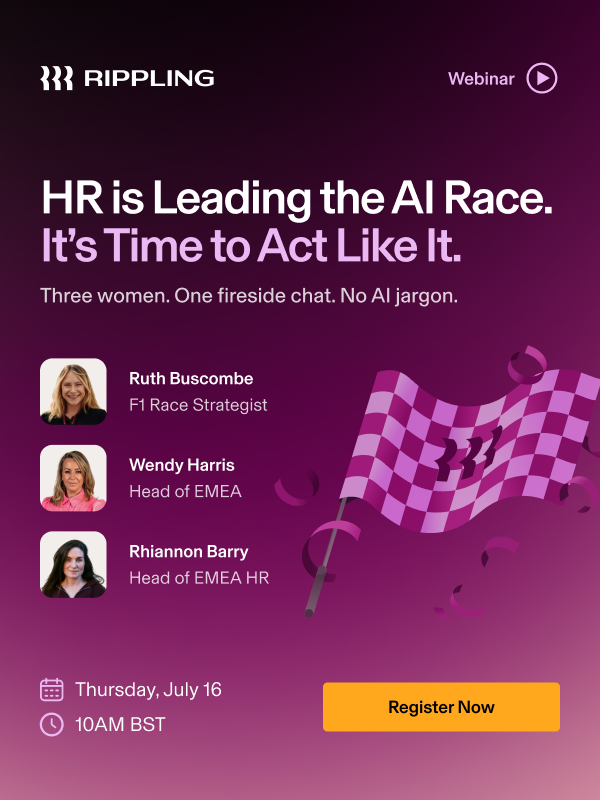
| Octopus HR team is intentionally designed to own the infrastructure that makes leadership accountability possible. | | Sponsored: When data moves fast, who makes the call? | HR teams that let AI handle the operational layer free themselves up for the decisions that actually need a human. But where's the line?
Join Rippling and F1 for a conversation about AI, data, and where human judgment still has to win.
REGISTER NOW → |
| |  |
|
| |
|
| | | Want a No-HR model? 5 tests to see if you’re ready | Octopus Energy’s No-HR model sounds interesting. Also… terrifying 😅 And maybe, for a tiny second, tempting. | Because almost every HR leader I speak to is exhausted from chasing managers, translating business problems into people processes, being pulled into every difficult conversation, while the workload grows and the team doesn't. | Before we jump to "How do we copy Octopus?", it is very important to start with: | "What would need to be true in our business before this would work?" | Because removing HR from the middle doesn't automatically create leadership accountability. Sometimes it just removes the only thing holding the mess together… yikes! 😬 | 5 tests to know if your organisation is ready for No-HR | 1️⃣ The trust test | “Do you actually trust your leaders to make people decisions?” | Pay. Promotions. Performance calls. Hiring trade-offs. Engagement interventions. Conflict. | If the answer is no, be honest. Because "we want leaders to own people accountability" sounds great… until a leader makes a decision their manager disagrees with, and sends it straight back to HR for "guidance." | A high-trust model means leaders make decisions close to the work, explain their logic, and carry the consequences – even when the decision looks different from what HR, or the founder, would have made. That's a very different muscle. | Enable your leaders: Pick one people decision HR currently approves or heavily influences. Put in place what the leader closest to the work needs to own it instead. |
|
| 2️⃣ The consequence test | “When leaders get it wrong, who feels the consequence?” | Many companies say they want leadership accountability, but keep HR as the rescue route. At Octopus, when a leader gets it wrong, accountability moves up the chain. Not sideways into HR, and that distinction matters. | Leaders only build the accountability muscle when they have to live with the outcome of their own decisions. | Enable your leaders: Map one recent people issue that landed with HR but should have stayed with a leader. Understand why it happened, then create a plan for leaders to own similar situations in future. |
|
| 3️⃣ The capability test | “Can your leaders carry the accountability you want to give them?” | Can they have difficult conversations early? Explain pay decisions clearly? Spot performance patterns before they escalate? Interpret engagement data without waiting for HR to translate it? | More accountability doesn't automatically create better leaders. The capability has to be there first. | Enable your leaders: Identify the one capability leaders need most to own people accountability. Just one. Then design the smallest practical support that helps them practise it in the flow of work. |
|
| 4️⃣ The visibility test | “Can leaders see what they need to act on, without waiting for HR?” | If engagement drops, can they see it? If pay is drifting out of line, can they check it? If performance is slipping, can they spot it? | A No-HR model only works when leaders have direct access to the information they need. | Enable your leaders: Identify one piece of people data leaders regularly ask HR to interpret. Then plan how to make it visible, understandable, and actionable for leaders directly. |
|
| 5️⃣ The discomfort test | “Where is HR absorbing discomfort that leaders should be learning to carry?” | This is probably the most important test, because most HR teams are unconsciously absorbing leadership discomfort: | The discomfort of a leader avoiding conflict. The discomfort of a manager not knowing how to give feedback. The discomfort of a founder wanting consistency without doing the hard work of alignment. The discomfort of a team being unclear, frustrated or under-led.
| Enable your leaders: Look at your HR workload this week. Which tasks are true HR infrastructure that enables leaders, and which are leadership discomfort handed to HR? Set one clear boundary, so the accountability stays where it belongs. |
|
| A word of warning: Shaky foundations don't scale | It’s tempting to copy the parts that personally resonate with us — such as removing People Partners, cancelling performance reviews, or decentralising pay decisions. But remember, this is not a pick-and-mix model 🍬. The No-HR model works at Octopus because their 6 Foundations reinforce each other. | High-trust principles support decentralised structure. Decentralised structure requires leadership capability. Leadership capability is supported by systems. Systems produce data. Data enables local decisions. Local decisions serve the strategy.
| Pull one Foundation out, and the whole system breaks. As Cynthia put it at the end of our conversation: "Really challenge why you do certain things. Ask yourself: what value does this add? Should we even be doing it?" | If you want the benefits of a No-HR model, the work isn't about copying one Foundation. It's about examining the whole system and being willing to change it. | | |
|
| | Step up from HR Leader to Business Leader | Ready to influence strategically, drive business impact and make HR indispensable?
Here are 3 ways I can help: | |
|
| | | You can now ‘LISTEN’ to the newsletter | I’ve turned my newsletter into audio, voiced by AI podcasters. It’s in beta, so give it a listen and tell me what you think! | |
|
|
|
| |
|


