| TL;DR | 💹 HR Leaders belong in QBRs: How to add strategic value | 😎 Who says HR can’t run QBRs? Here’s how | 🎧 Listen to the newsletter here | This newsletter edition is brought to you by Zelt 💛 | |
|
| | | What’s this? A mission worth joining. A prize you don’t want to miss. | |
|
| | | Statement: I’ve never seen an HR leader join any QBRs in my career | | | | CMO |
|
| HR Leaders belong in QBRs: How to add strategic value | 😱😱😱😱😱😱😱😱😱😱 (Yup, that was my first reaction.) | HR leaders, if you are not in the QBR, you’ve already vacated your strategic seat. | I’m saying this without judgment, because I’ve made this mistake myself. | Early in my career, when a QBR invite landed in my calendar, my internal reaction was: “Eurgh. Another meeting I have to show my face in. I could read the summary later.” (I never did.) | I remember one session vividly. The leadership team was debating 2 customer segments and struggling to expand into one of them. Not people stuff, I thought — so I switched off and started drafting an engagement report instead. | When HR leaders think, “I don’t have anything to add in the QBR,” what they usually mean is: “I’m treating HR as downstream execution, not upstream strategy.” | A strategic HR leader cannot afford to be absent from the QBR | Because a QBR isn’t just a meeting. It’s a direction-setting and prioritisation ritual for the next quarter, aligned to the annual goals. | It exists so the business can answer one core question: | | ❝ | | | Where are we against this quarter’s business results — and what will we prioritise (or drop) next? |
|
| While the business is deciding whether to increase revenue by doing X, pivot product by doing Y, or grow market share by doing Z...this is exactly when HR should be in the room, contributing. | In newsletter #26, I shared that I decided I no longer wanted to sit at the corner of the exec table, feeling like an outsider, so I chose QBRs as one of my training grounds. I stopped trying to multitask during QBRs and made a conscious decision to be part of the conversation. | It was daunting at first, but I started by focusing on doing 3 simple things: | ADD insight that shapes decisions ASK questions others aren’t asking ALIGN decisions to operational reality
| (I call it the 3A’s 😉. Easy for you to remember when the next QBR rolls around.) | Contribute and add value to QBR with the 3A’s | Let’s say the business decides to ‘increase revenue and prioritise enterprise expansion next quarter.’ | Here’s how a strategic HR leader shows up in that conversation: | 1. ADD insight that shapes decisions | “Our revenue growth projection for next quarter assumes a time-to-first sale of 5 months. Based on our last 9 months of onboarding data, Enterprise AEs typically close their first deal in 6 - 9 months. We therefore need to either revisit the projection assumptions or prioritise initiatives to reduce ramp-up time.” | 📌 Your insight slows the room down just enough to make better decisions. | 2. ASK questions others aren’t asking | “Our enterprise AEs have flagged difficulty closing deals due to a lack of ISO certification. I don’t see this prioritised next quarter, how does that affect our confidence in this target?” | 📌 You’re asking an executive leadership question; it doesn’t belong to Sales or Product alone. | 3. ALIGN decisions to reality | “Our Customer Success team is already at capacity. Without additional support, onboarding enterprise clients will create delivery risk.” | 📌 You’re ensuring good decisions don’t become bad execution. | But what if you don’t have QBRs? | You’re not alone. Many start-ups building to scale haven’t formalised this yet. And if it doesn’t exist, don’t wait for the CEO, COO or CFO to create it. | | ❝ | | | Initiating a QBR rhythm is a strategic contribution. |
|
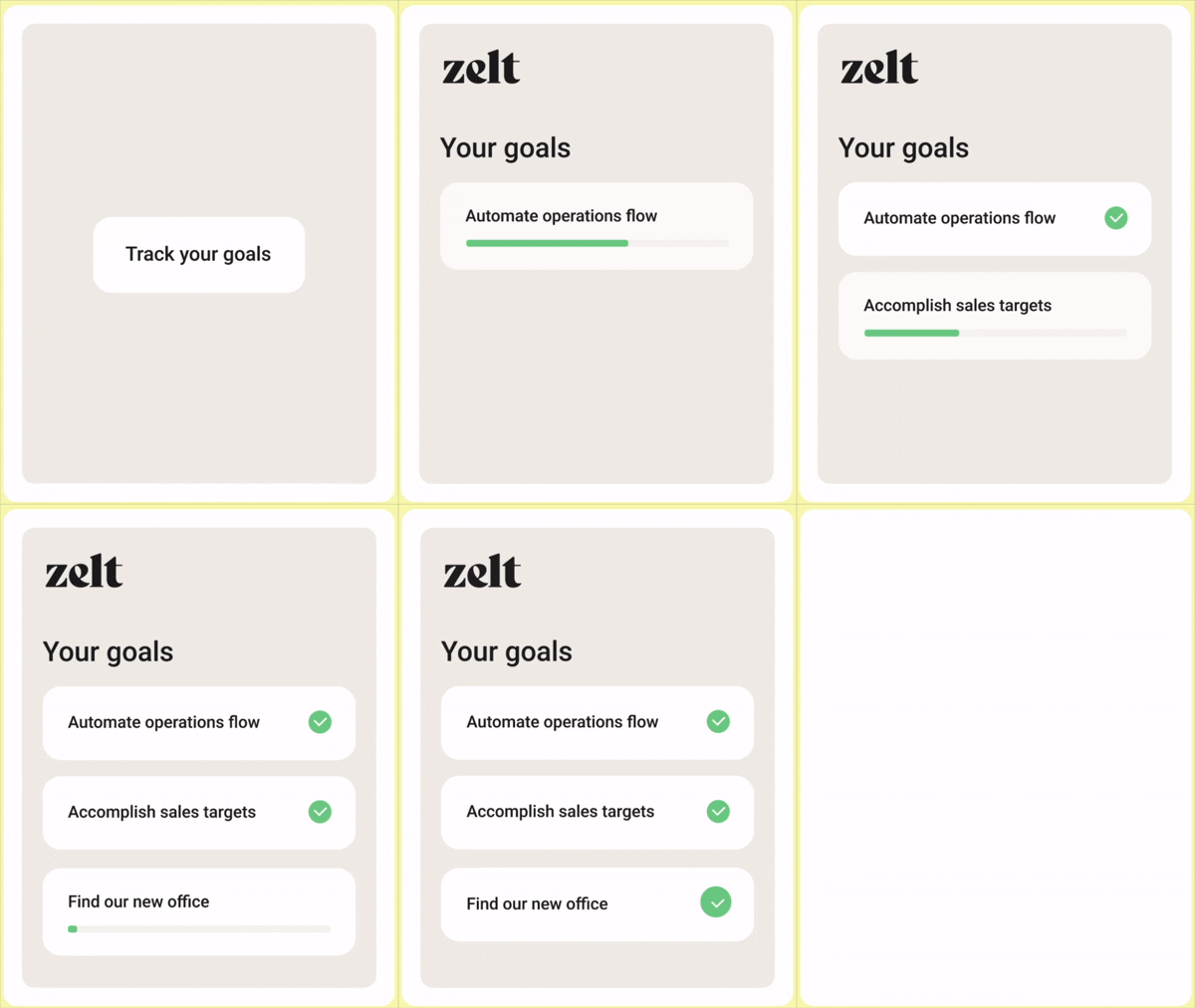
| Because scaling isn’t about doing more HR. It’s about helping the business make better decisions — earlier, and with fewer surprises down the line. | | As an HR leader, do you join your company’s QBRs? | | | Sponsored: Don’t be the only person at QBR without a dashboard | Nothing feels worse than being the only leader without hard data. When goals are scattered or unclear, HR has failed the business.
Zelt centralises objective and results for all departments in one view, so you can measure the pulse of the business and enable good decision making at the Board.
📺 Watch the demo to see how → |
| |  |
|
|
|
| | | Who says HR can’t run QBRs? Here’s how | Too many QBRs feel like extended exec meetings. Same updates, same slides, same polite nodding around the table. Just…longer🤯. | Before the calendar invite goes out, ask: “What must be different after this meeting?” | If the answer isn’t clearer priorities, explicit trade-offs or deliberate decisions — repeat after me: don’t bother running the QBR. | Wait, isn’t there a QBR agenda template? | 👉 Click here if you’re looking for QBR template. Honestly, ChatGPT could whip one up before you can say “admin” 😉. | But that’s not what makes a QBR valuable. | What’s hard is the tight facilitation and shared understanding needed to make your QBR genuinely valuable. That’s where most QBRs fail — a sloppy attempt to tick the “best practice” box without driving real alignment, decisions or commitment. | 3 Non-negotiables to run a valuable QBR that moves the business | I’ve learned that must come to life for a QBR to do what it’s meant to: move the business forward. | 1️⃣ Set clear expectations, BEFORE the meeting begins | It’s easy to assume your execs know what’s expected. After all, they’re experienced leaders, right? | Err…wrong. We made that assumption once and the result was a derailed QBR. Different people came in with different expectations — some ready to present polished progress updates, others hoping for strategic discussion. The tension in the room was palpable. Worse, when the mismatch was called out, people got defensive. | Since then, I’ve always align expectations upfront. Here’s what we make explicit: | This is outcome-focused, not activity-focused. This is not a presentation of department’s progress, but holistic business progress. We care about what moved the business, not ‘busywork’. Trade-offs are expected, this is where we make them. We’re here as one leadership team, not as function reps. (This one’s my favourite. I send this Lencioni video before every QBR — yes, every time. Because there’s always a new face, and alignment isn’t a one-off.)
| It might sound basic. But making it explicit ensures the QBR starts with alignment, not assumptions. | 2️⃣ Only discuss business-level metrics | QBRs are not a showcase for every department’s dashboard. You need to zoom out and focus. | At the business level, we typically anchor on one key metric from each of the 3 core pillars: | Product / Customer (e.g. time to value, NPS) Commercial Growth (e.g. revenue, market share) Business Health (e.g. gross margin, EBITDA, productivity)
| (These should reflect your biggest business bets, the metrics that matter most this year.) | If you have strong business clarity, you may only need one clear north star metric. That’s rare, but powerful. | A simple rule of thumb: If a metric doesn’t influence a business decision, it doesn’t belong in the QBR. | Department-level metrics still matter — but only as supporting insight to help illuminate business-level priorities. They’re context, not the main event. | 3️⃣ A good facilitator is a must | The best QBRs I’ve attended had one thing in common: excellent facilitation. | Not someone who simply moves the agenda along. But someone who: | Holds the room to the intended purpose Surfaces tensions and forces trade-offs, not smooths them over Knows when to pause the conversation and ask, “What decision are we trying to make here?”
| Ideally, this is the CEO. In reality, that’s often not possible in start-ups, especially for first-time founders or leaders who’ve never run a QBR before. So choose someone else who can hold the room to the outcome. A senior exec with a strong cross-functional understanding works. Even better, a neutral third party (like a trusted advisor) who isn’t afraid to challenge and redirect when needed. | QBR is not “someone else’s priority” | HR leaders, this is a strategic leadership ritual. If you don’t have one, this is your guide to creating it. If you do have one, this is your guide to making it better. | Either way, don’t leave it to “someone else on the exec team” and limit yourself to HR-only rituals. | This is your strategic contribution. | |
|
| | Step up from HR Leader to Business Leader | Ready to influence strategically, drive business impact and make HR indispensable?
Here are 3 ways I can help: | |
|
| | You can now ‘LISTEN’ to the newsletter | I’ve turned my newsletter into audio, voiced by AI podcasters. It’s in beta, so give it a listen and tell me what you think! | |
| |
|
|
| |
|