Travel Tech Essentialist #200: Remarkable
- Mauricio | Travel Tech Essentialist <traveltechessentialist@substack.com>
- Hidden Recipient <hidden@emailshot.io>

Many travel companies grow by buying traffic. A few grow because customers do the work for them. This issue is about what creates that second kind of growth. 1. Make something worth remarkingA message in a bottle thrown from a Canadian ferry just washed up in Scotland. It traveled 4350 km, survived two winters at sea, and was found intact on a beach by a dog. People are sharing it everywhere. The bottle has no utility. It just has an improbable story, and improbable stories are remarkable in the original sense: worth remarking about. Psychologist Robert Plutchik defined delight as Joy + Surprise. The bottle delivers both. Travel products tend to get built around function. Ease of booking, speed of check-in, seamless payments. All of it matters, but almost none of it gets remarked about. Pack Up + Go lets customers book a trip without knowing the destination. Days before departure, an envelope arrives: “You’re going to ______,” to be opened at the airport. People film it, photograph it, share it everywhere. No utility. Just an improbable moment landing exactly right. Most travel products optimize for certainty; Pack Up + Go introduces uncertainty at exactly the right moment, delivering both surprise and joy. Like the bottle, it’s not the object that matters. It’s the story it tells. If customers don’t have a reason to talk about you, growth has to come from somewhere else, and it’s usually expensive.
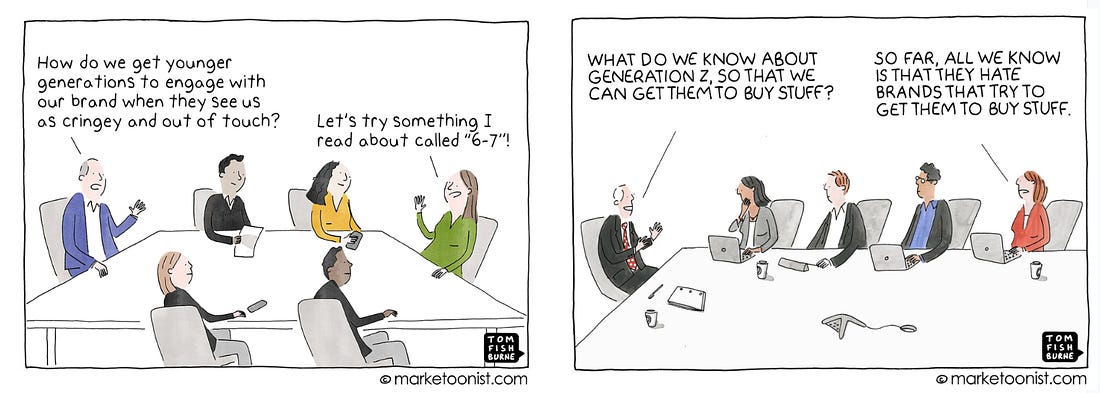
2. The brand testSeth Godin draws a useful distinction. If Nike announced they were opening a hotel, you’d have a pretty good idea what it would feel like. If Hyatt announced they were making shoes, you’d have no idea whatsoever. Casa Camper did exactly that. The Spanish shoe brand opened hotels in Barcelona and Berlin, and anyone who knew Camper could predict what they'd feel like: understated, design-led, and slightly unconventional. Godin's answer to what builds a brand: a sustained point of view, the confidence to make an assertion, and the discipline to deliver on it consistently. Through design, service, and product, not through logos or ad spend. That's a longer game than most companies are willing to play. Try it with any travel company you know. If they announced a product in an adjacent space, would you have a clear sense of what it would be like? If not, they don’t really have a brand yet. 3. Small signals, big brandsEli Strick, Head of Customer Experience at Wells Fargo, shared a simple CX framework from Marriott’s CCO: get the basics right → make it easy → connect emotionally. For the last one (connect emotionally), small gestures can make a big difference. Strick’s example is how a plate of matzah during Passover in a United Club lounge would have cost almost nothing. He’d probably skip it himself, but he would notice and would appreciate the thought behind it, and that’s the point. Ideas like this are easy to come by. What’s rare is seeing them repeated day after day across hundreds of locations and in the small moments that matter to travelers. That’s where most brands lose consistency. The ones that get this right build something competitors can’t easily copy. 4. Trying too hardThe number one reason younger consumers reject brands is that brands try too hard to reach them. Generational targeting is mostly a distraction from the harder work: building something worth noticing. Most of the time, “trying too hard” shows up as marketing doing the work the product should be doing.
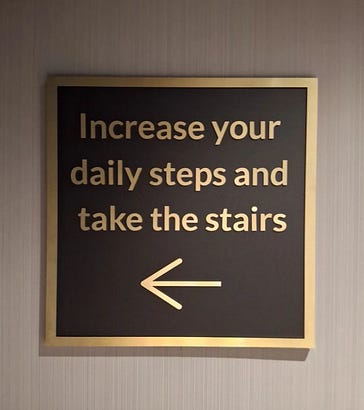
5. Brand in a signDanica Smith says it well: “If a sign makes me laugh, I already like the hotel more. Low cost. High impact. Pure personality.”
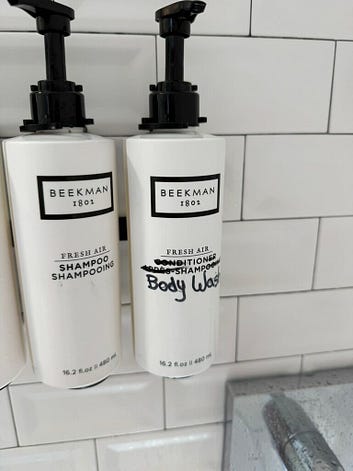
6. Brand in a bottleTim Peter spotted this in a hotel bathroom. Whether it reads as careless or committed to sustainability depends entirely on everything else the hotel has already made you feel by the time you reach the bathroom.
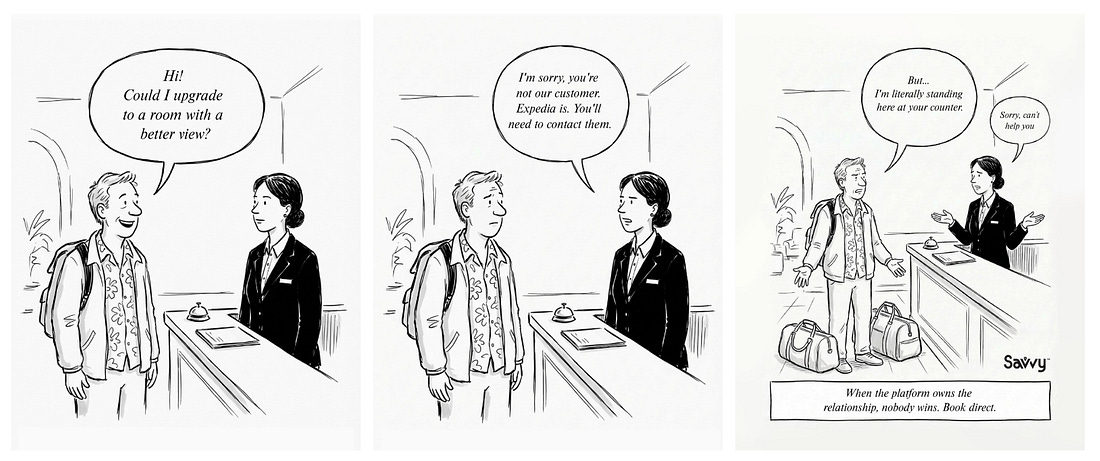
7. The guest in front of you is your customerIn 2019, I shared this quote by Dara Khosrowshahi (then CEO of Expedia and now CEO of Uber), speaking to hoteliers:
The cartoon below, published by Savvy, makes the same point. The hotel has a chance to make them a direct customer for life, and they pass.
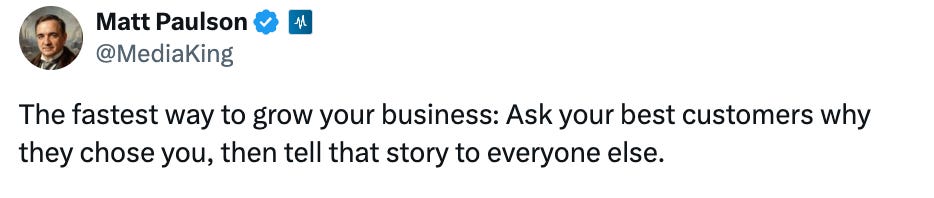
8. Your customers knowMost companies survey everyone and hear mostly noise. The signal is in your best customers; the ones who came back, referred someone, or chose you over a cheaper option. Ask them why. The answer is usually simpler than whatever your marketing team came up with.
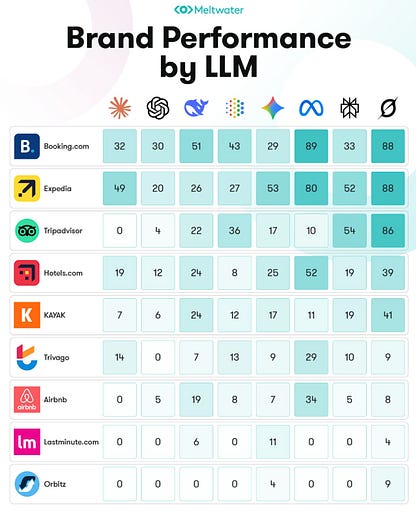
9. The new brand battlefieldHeadlines such as ‘Cracks Emerge in the OTA Oligopoly' reflect the prevailing view that AI spells trouble for OTAs. Meltwater just tracked which travel brands LLMs recommend most across prompts and models. Both Booking.com (55% visibility) and Expedia Group (54% visibility) dominated AI-generated recommendations for Europe in spring 2026, while Tripadvisor, Hotels.com, and Kayak lag far behind. Meltwater has a product to sell (so treat the numbers as directional rather than definitive), but the signal is that even in an LLM-first world, the brands that won the last era of online travel are still dominating in today’s AI search. The question this data doesn't answer is what share of traffic and bookings is starting with an LLM today. Also worth noting: a few European OTAs with meaningful market share in Europe don't appear in this list at all. For them, the conversation about LLM visibility is even more urgent.
10. Parkinson’s Law in the age of AILast issue I wrote about an HBR study showing AI intensified work rather than reducing it. Parkinson’s Law explains why that was predictable. The law says work expands to fill the time available. It held up for 70 years because time was the constraint. AI removed that ceiling. The law hasn’t changed, but the constraint has. Work now expands to fill capacity, and expectations rise with it. Time limits are obvious, but capacity limits have no natural ceiling, and neither do expectations. No one calls them out and the expansion just happens until it feels normal. That’s not necessarily bad but it is worth knowing it’s happening. 🧭 Travel Tech Essentialist CopilotAcquisition costs rising? Users not coming back? Absent in LLM answers? A pitch that doesn’t land…. The Travel Tech Essentialist Copilot will help you figure out what's holding you back. If you try it, hit reply and let me know what you think. Travel Tech Essentialist Job Board→ Explore all 2144 open roles on the Travel Tech Essentialist Job Board now.
📩 For monthly updates on the latest roles, subscribe to the Travel Tech Jobs newsletter Raising a round?If you are a startup looking to raise a round (from pre-seed to Series D), I can help (for free). Travel Investor Network is a private platform where I recommend innovative travel startups to investors and innovators. If you’re interested, please start by completing this form. This is issue 200. If you’ve found value in Travel Tech Essentialist, the best way to say so is to share it with someone who’d appreciate it: If you’re not yet subscribed, join us here: And, as always, thanks for trusting me with your inbox. Mauricio Prieto
|






Similar newsletters
There are other similar shared emails that you might be interested in: